Anthropic reportedly overtakes OpenAI on revenue for the first time
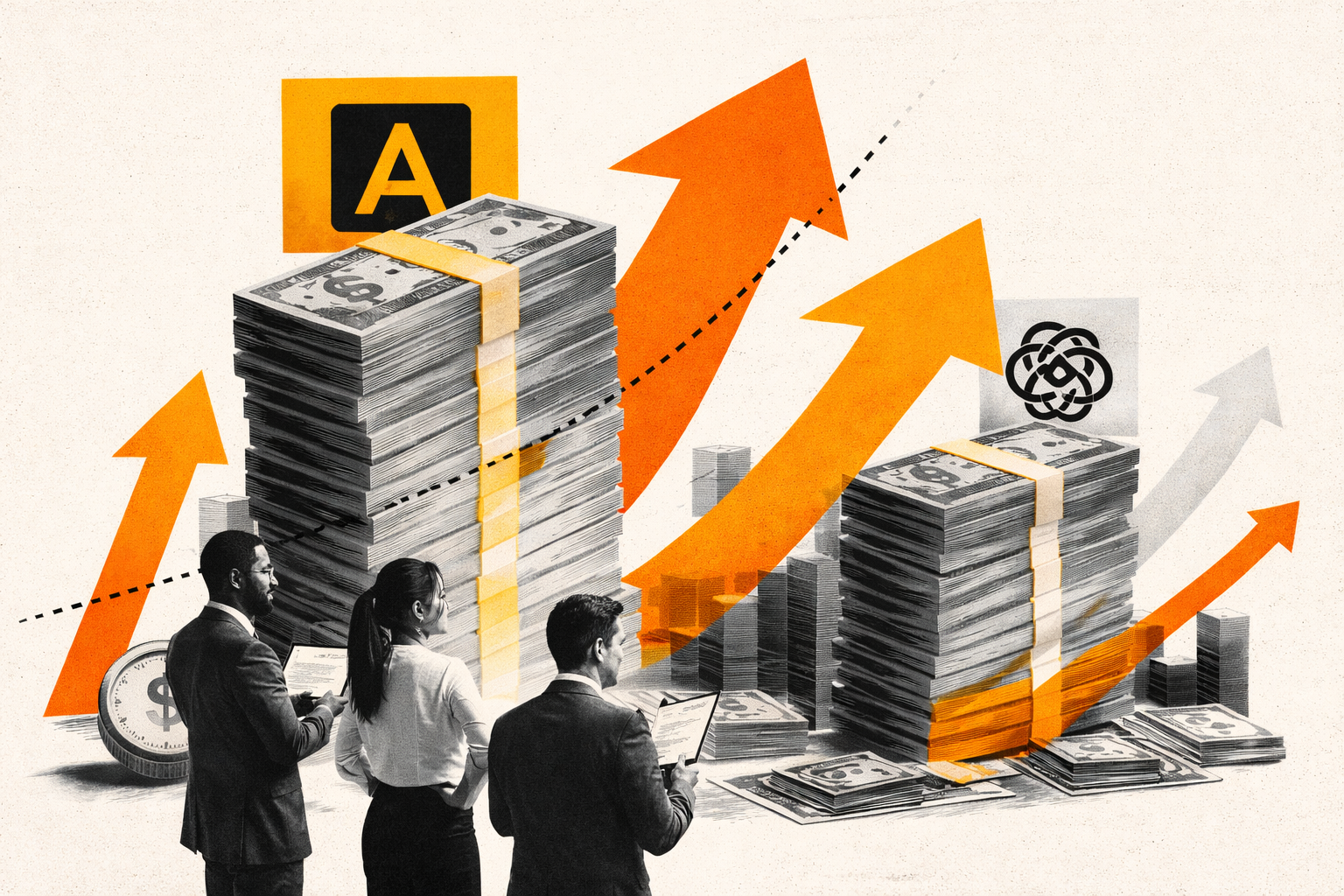
The number that caught my eye was not the $30 billion. It was the speed. Anthropic closed February 2026 on $9 billion in annualised revenue. Six weeks later, it was reportedly running at three times that. For context, most enterprise software companies would consider themselves fortunate to add a few percentage points of ARR in a quarter. Anthropic has more than tripled its run rate in roughly four months, and in doing so has, according to reporting aggregated by Roborhythms, pulled ahead of OpenAI's $25 billion ARR for the first time.
That is worth sitting with for a moment before we reach for the league table.
For a couple of years now, the dominant narrative in AI has been a consumer one. ChatGPT as cultural phenomenon. Image generators on everyone's phone. Teachers worrying about homework. That narrative is not wrong, but it has made it easy to miss what has been quietly happening inside procurement departments, legal teams and boardrooms.
Anthropic's revenue mix tells that other story. Its business is reportedly around 80% enterprise, against a more consumer-heavy OpenAI. One company is selling subscriptions to individuals who might cancel next month. The other is signing multi-year contracts with organisations that do not change their mind lightly.
The enterprise detail I found most revealing was this: clients spending over $1 million a year with Anthropic reportedly doubled from 500 to 1,000 in under two months after its Series G. That is not curiosity money. That is committee-approved, legal-reviewed, chief-information-officer-signed budget. When a thousand serious organisations are each writing seven-figure cheques for the same vendor, something structural is shifting underneath the noise.
So what is actually being bought?
In my experience working with senior leaders on AI adoption, the companies moving fastest are not the ones chasing the most capable model. They are the ones that have done the boring work first. They have mapped where judgement lives in their processes. They have figured out which decisions can be automated, which should be augmented, and which must stay firmly with a human being. They have worked out their risk appetite, their governance model and their accountability chain before they have worked out their vendor. The tooling follows the thinking, not the other way around.
That is why I read Anthropic's numbers less as a story about one lab beating another, and more as a signal that enterprise AI has moved past the pilot phase. Organisations are not asking whether to use these tools. They are asking how to use them without creating messes they will have to clean up for the next decade. Questions about explainability, liability, data residency, human-in-the-loop design and staff capability now sit on the agenda alongside cost and capability.
There is also a harder question underneath the celebration. Anthropic has reportedly locked in a 3.5-gigawatt compute deal with Google and Broadcom, with capacity coming online in 2027. Three and a half gigawatts is not a product decision. It is an energy-and-infrastructure decision that will shape power grids, water use and local economies. The companies winning this race are no longer just software companies. They are industrial actors. Leaders buying their services should be asking where that compute is physically landing and who is absorbing its costs.
A few things I would take from this if I were advising a board this week. Revenue leadership in AI is now decided in enterprise, not in app stores, so benchmark your AI strategy against how peers in your sector are contracting, not against what is trending. Growth of this shape is a warning as much as an opportunity: vendor concentration is creeping up, and switching costs will only get higher from here. And the organisations getting real value are not the ones with the biggest licence. They are the ones whose people have the literacy, judgement and permission to use these tools well.
Machines are getting better at machining. The money is finally following that fact. What remains an open question, for every leader reading this, is whether your people are getting better at the work only people can do.
One thing to ask in your next leadership meeting: if our AI vendor doubled its prices tomorrow, what would we actually do?
.png?width=783&height=479&name=BBE%20Logo%20Teal%20Background%20(1).png "Bykov-Brett Logo")
 Jamie Bykov-Brett
·
20 April 2026
·
4 min read
Jamie Bykov-Brett
·
20 April 2026
·
4 min read