.png?width=783&height=479&name=BBE%20Logo%20Teal%20Background%20(1).png "Bykov-Brett Logo")
 Jamie Bykov-Brett
·
05 October 2025
·
6 min read
Jamie Bykov-Brett
·
05 October 2025
·
6 min read
Picture the quarterly strategy meeting. Someone drops the phrase "agentic AI." Half the room nods sagely; the rest are suddenly typing under the table.
Here's the quiet truth: the majority of the time when people are discussing "AI," they're really talking about workflow design. Intelligence is just the plumbing, how data, decisions, and actions flow (and sometimes loop) from A to B. Get the plumbing wrong and even the smartest model either drips…or floods.
The four rungs of the workflow ladder
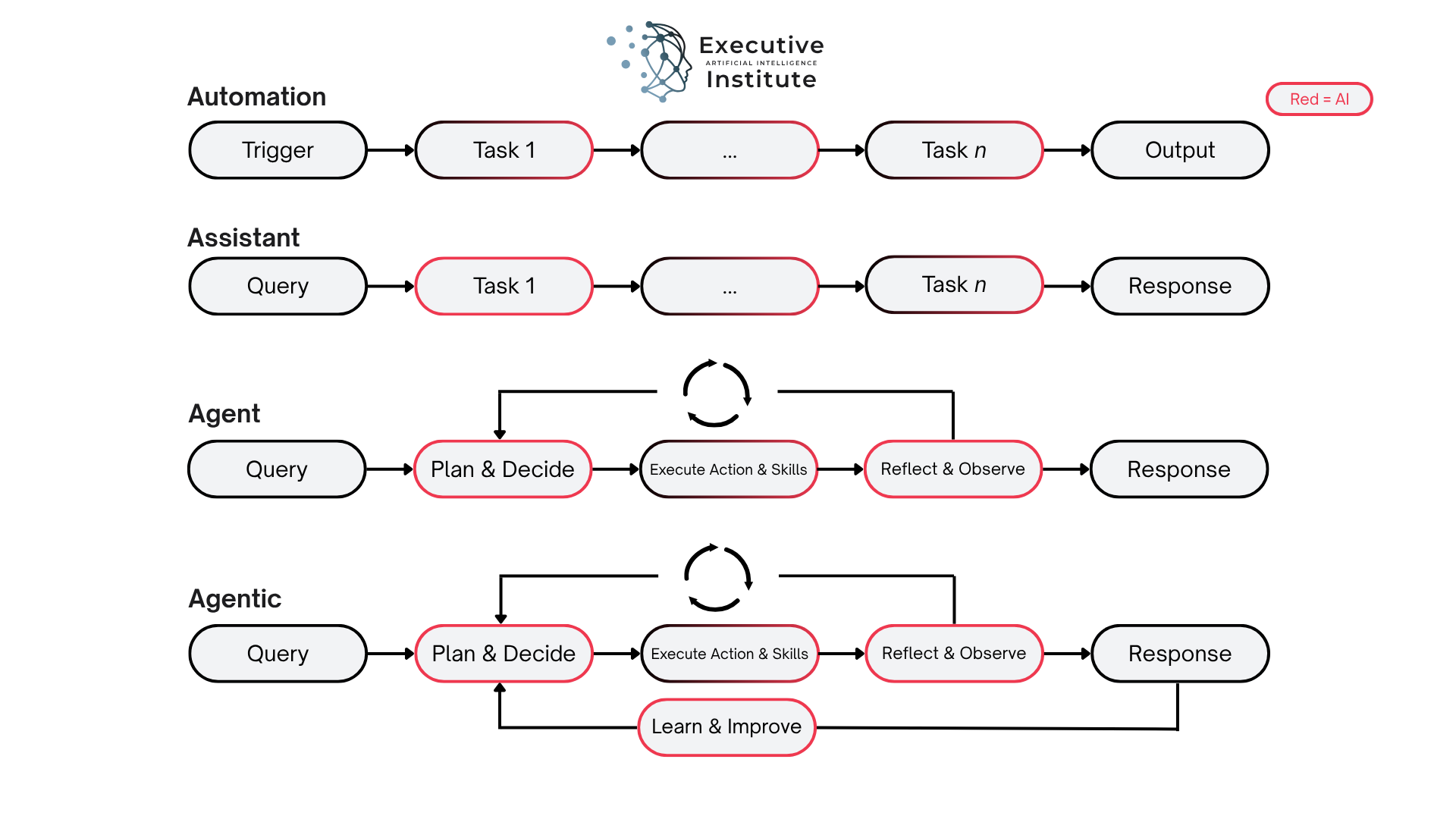
A no-spreadsheet tour of modern workflows, tuned to how these systems actually behave in the wild.
1. Automation: the rule-following robot
A single trigger fires a rigid chain of pre-set tasks, no questions, no feedback. Think "When new flights to Paris are added to the system, send me a notification."
Where it shines:
- Payroll
- Nightly backups
- Routing, anything repetitive and predictable
Watch-outs: One unexpected input stops the conveyor belt. Little room for nuance or graceful failure.
2. Assistant: the fast-talking fact finder
You ask, it answers. "Siri, what's the capital of France?" A language model retrieves and packages information.
Where it shines:
- Instant Q&A
- Summarising docs
- Drafting emails, lightweight tasks that live entirely in language
Watch-outs: It can't act on the world. Ask it to book the Paris flight and it'll hand you trivia, not tickets.
3. Agent: the autonomous doer
The system perceives its environment, chooses tools, and executes multi-step plans to achieve a goal. Think "Find the best flight to Paris, book it, and send me the confirmation."
Where it shines:
- Market scans
- Booking workflows
- Data-driven decision support
Watch-outs: Autonomy introduces real-world risk. Without guard-rails, agents can overspend, over-share, or simply overdo.
4. Agentic: the self-improving strategist
Everything an agent does, plus a learning loop, and sometimes minus the initial trigger. An agentic system can run continuously, spotting patterns, launching actions, and refining itself without waiting for your nudge.
Think a 24/7 Paris travel concierge that tracks airfare dips, pounces on lower fares, auto-reserves your favourite Left-Bank hotel, shifts dinner bookings when the Eurostar is late, updates your calendar, and learns each time you insist on a window seat and a breakfast croissant.
Where it shines:
- Personalised coaching
- Adaptive supply chains
- Self-optimising customer journeys, anywhere "better tomorrow" is the value proposition
Watch-outs: Governance, explainability, and cultural inclusion hit centre stage. If it decides when to act as well as how, oversight must be baked into the design, not tacked on later.
Reality check: most workflows live in the grey
The ladder is handy for clarity, yet real projects often sprawl across multiple rungs.
- Hybrid chains: An automation pipeline may hand off to an assistant for a human-in-the-loop decision, then flip back to automation for fulfilment.
- Progressive upgrades: Yesterday's assistant gains a reflection loop and creeps toward agent territory before anyone updates the slide deck.
- Context drift: A booking agent might default to assistant mode during low-traffic hours, then switch to fully agentic optimisation when demand spikes.
In practice, the boundaries blur and nomenclature is open to interpretation. That's fine, just be explicit about what your system can (and cannot) do.
Why investors can't stop saying "agentic"
"Agentic" smells like exponential upside, so it lights up every VC deck. But branding a glorified FAQ bot as agentic doesn't make it self-start or self-learn. Before promising the world, ask:
- Feedback fuel: Do we capture the data that can teach the system?
- Safety rails: How will we detect and correct runaway behaviour, especially if it acts without prompting?
- Business fit: Does this workflow need continuous, autonomous improvement, or will a crisp assistant suffice?
Many early wins lurk on the lower rungs. Automate the dull chores, add assistants for instant answers, graduate to agents when tangible value, not FOMO, demands autonomy, and climb to agentic only when continuous improvement materially moves the needle.
Litmus test for leaders
- Complexity of decision: Low stakes and fixed logic? Automate.
- Frequency of change: Requirements shift weekly? Consider an agent.
- Need for adaptation: Tomorrow's answer must beat today's? Agentic earns its keep.
- Regulation & risk: The higher the rung, and the more self-starting the system, the tighter your audit trail needs to be.
Executive reflection prompts
- Which trivia can an assistant clear off our team's plate today?
- Where would an always-on agentic loop create outsized value, or unacceptable risk?
- How will we define and measure "improvement" without drowning in vanity metrics?
Bring these to your next leadership huddle. Align on workflow first, model second, and strategy writes itself.
From insight to momentum
At the Executive AI Institute, our mission is simple: guide senior leaders through AI disruption with a human-centric lens. Whether you need a one-hour Executive Insights briefing or a half-day Strategic Momentum workshop, we blend world-class leadership psychology with deep technical mastery. Relationship-first beats transaction-first, every time.
The takeaway
AI isn't magic, it's plumbing. Choose the right pipes today and you'll bathe in tomorrow's opportunities instead of mopping up leaks. Ready to map your ladder? The first rung is just a conversation away.
Jamie Bykov-Brett
Listed as one of Engatica's World's Top 200 Business and Technology Innovators, Jamie is an AI and automation consultant who helps organisations move from curiosity to confident daily use. As founder of Bykov-Brett Enterprises and co-founder of the Executive AI Institute, he designs AI upskilling programmes that have delivered 86% daily adoption rates and a 9.7/10 NPS. His work sits at the intersection of technology implementation and human development, with a focus on responsible governance, practical tooling, and making AI accessible to every level of an organisation.
Get AI Insights Delivered
Practical perspectives on AI adoption and the future of work. No spam.