Given I have spent the last week in the hospital ICU, I thought I would be prudent to announce my return to work with a piece about AI in clinical settings.
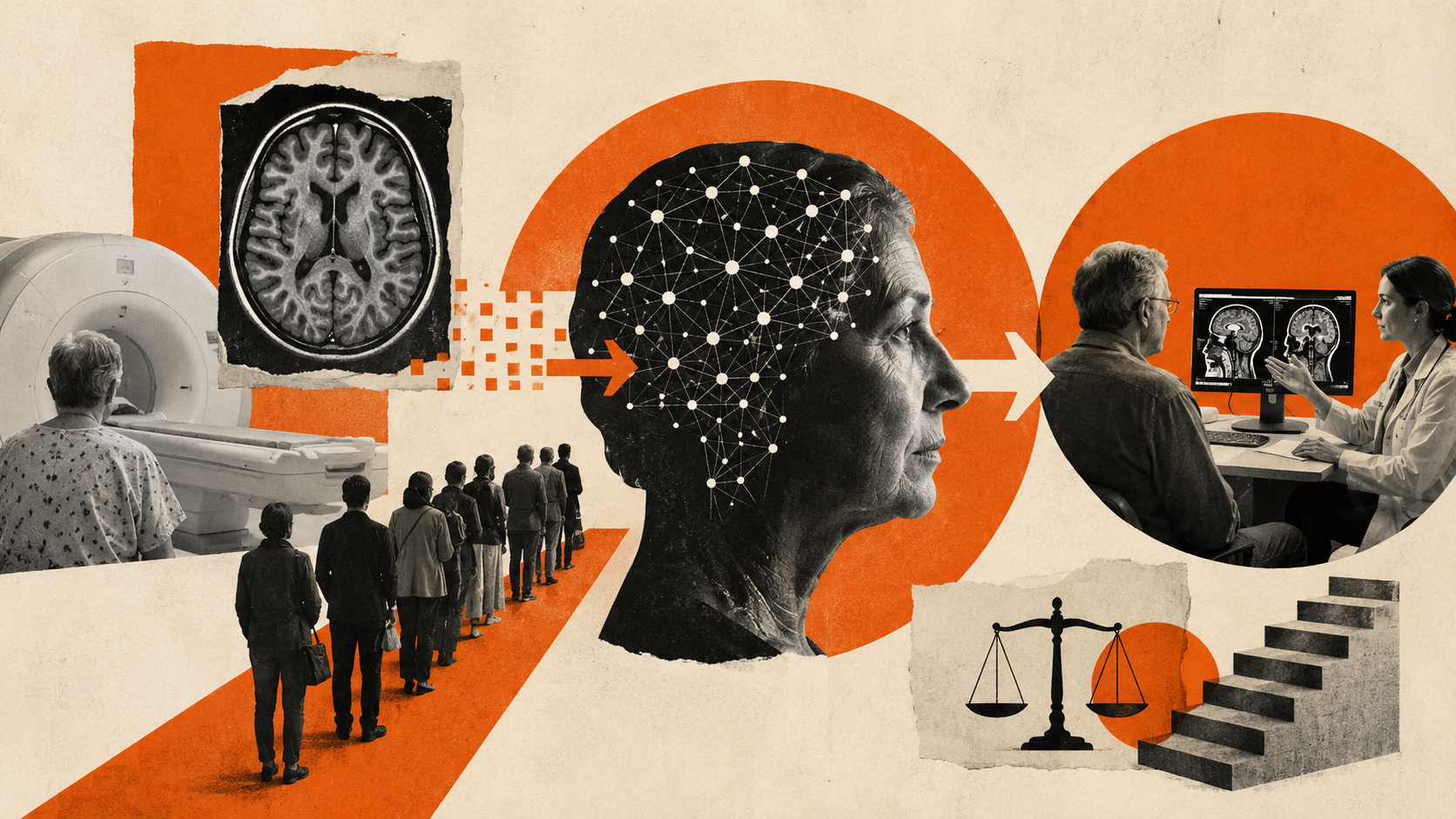
A single baseline MRI, a few demographic details, and a model that can forecast whether a person's cognition is likely to decline. That is what a team at UC San Francisco has just published in Nature Aging. What the tool deliberately leaves out is more interesting than the accuracy claim itself.
No PET scan. No genetic panel. No cerebrospinal fluid proteomics. No baseline cognitive assessment from a neuropsychologist. The researchers, led by Ashish Raj at UCSF, built a multitask deep learning framework that predicts Alzheimer's diagnosis, tissue segmentation, and both current and future cognitive scores from one scan most clinics already have the means to take. First author Daren Ma frames it as a way to give clinicians a quick prediction before referring a patient on to a more advanced imaging lab or a full neuroradiology report.
That sentence is the whole story.
Removing a queue rather than a clinician
Most AI-in-healthcare conversations get stuck on the wrong question. People ask whether the model is better than the specialist. The more useful question, almost always, is whether the model gets the patient to the specialist faster, or helps a clinician decide who needs the specialist at all. The UCSF tool is squarely in that second camp. It triages instead of pretending to replace a neuropsychologist's battery or a neuroradiologist's read. It tells a clinician earlier in the process whether the picture warrants the cost and time of a deeper workup, and the wait list that comes with it.
For anyone sponsoring AI work inside a hospital, a research institute, or a university spin-out, that distinction is the one to internalise. Tools that try to replace an expert provoke resistance from the people whose hands are on the work, and rightly so. Tools that shorten the queue in front of an expert tend to get adopted, because they make the expert's life easier and the patient's journey shorter. The clinician stays in the decision. The barrier that moves is access.
Why this design choice matters beyond Alzheimer's
The original authors of this research are careful about scope. They note that the same approach could help characterise the link between brain morphology and cognition in Parkinson's, ALS, and Huntington's. They also flag that predicting baseline cognition could matter in community settings where there are simply no specialised neurocognitive assessment skills available. That is an important point. A lot of the inequality in dementia care is about who ever gets close enough to receive a diagnosis, rather than the quality of the eventual diagnosis.
There is also a clinical trial angle that leaders in pharma and academic medicine should not miss. Raj argues that being able to separate likely progressors from non-progressors using only baseline data could shrink trial sample sizes and cost. Trials for disease-modifying drugs in Alzheimer's are notoriously expensive partly because so much of the cohort never progresses in the window being studied. A better filter at recruitment is, in plain terms, a cheaper and faster path to knowing whether a drug works.
The test to apply when you are sponsoring this kind of work
If you are a Head of Digital or a CDO in a clinical or research environment, the UCSF study is a useful reference point for the next AI business case that lands on your desk. Ask one question of it: does this tool replace an expert, or does it remove a queue in front of one? The first framing is hard to defend internally and hard to govern, and clinicians struggle to trust it. The second framing tends to clear procurement and ethics review, and to get through the ward round.
It is also the framing that holds up against the harder ethical questions. Who benefits? Patients who would otherwise wait months for a referral. Who is at risk? Patients in settings where the tool is treated as a verdict rather than a triage signal. The governance work flows naturally from there: clear escalation paths, human-in-the-loop sign-off, transparent reporting on false positives and negatives, and a refusal to let the model's output be quoted back to a patient without a clinician in the room.
The authors themselves say clinical utility will depend on specific use cases and require careful assessment in future studies. They have published a method and shown it generalises across two independent datasets without declaring victory. That restraint is itself part of why the work is credible.
.png?width=783&height=479&name=BBE%20Logo%20Teal%20Background%20(1).png "Bykov-Brett Logo")
 Jamie Bykov-Brett
·
26 May 2026
·
4 min read
Jamie Bykov-Brett
·
26 May 2026
·
4 min read