.png?width=783&height=479&name=BBE%20Logo%20Teal%20Background%20(1).png "Bykov-Brett Logo")
Is Alpha School's AI Curriculum the Future of Education?
 Jamie Bykov-Brett
·
08 June 2026
·
21 min read
Jamie Bykov-Brett
·
08 June 2026
·
21 min read
I left school with almost nothing. Seizures through my teens wrecked my attendance, my memory and most of my confidence. Paired with, at the time, undiagnosed neurodivergence, school was hell. By the time I was meant to be sitting exams I was using my technical skills to survive rather than to learn. I frequently broke into a teacher's laptop for the answers to tests and quizzes, and I would write small programmes attached to "homework" that did things like open the CD drive randomly every five or six minutes or throw up error messages to make them think their computer had a fault or had been hacked.
By 17 I was out, with barely a passing grade to my name. The things that turned my life around all happened after school, often in the more accommodating workplaces that taught me how to reward and leverage my neurodiverse talents/quirks rather than punish me for them. When I continued my academics later in life I would achieve a 100% distinction grade on level 7 qualifications.
My favourite quote is by the late educationalist, Sir Ken Robinson and the reason it is so important as it really highlights the failing of our current approach to education. [4]
Human communities depend upon a diversity of talent not a singular conception of ability. and at the heart of the challenge is to reconstitute our sense of ability and intelligence.
The core problem lies in the industrial education system's ability to prepare students for jobs that don't even exist anymore. It focuses on basic skills relevant to an outdated workforce and educates to the preferred learning of the middle of the bell curve, often leaving those in the fringes behind.
I start there because Alpha School is being sold as the opposite of that story, and I want to be honest about why I am drawn to it and where I think it falls down.
Alpha is the school everyone is arguing about. At Alpha school children do their core academics in roughly two focused hours a day using adaptive AI tutors and mastery-based progression, advancing only once they hit around 90 percent mastery, and Alpha says students grow at roughly twice the rate of their peers and reach top-percentile results. [1] That is the bit people fight over. It is also the least useful place to stop.
Because the interesting claim Alpha is making is not that a chatbot can teach maths faster. It is that if you can compress the parts of learning a machine is good at, you free up most of the school day for the parts a machine is terrible at. Communication. Creativity. Working with other people. Public speaking. Building something and selling it. Sitting with failure and going again. Alpha calls the adults "guides" rather than teachers and points the timetable at those human capabilities. [1] That is a real idea, and it is worth taking apart properly rather than dunking on the marketing.
The real argument is about reallocation, not automation
There is a weak version of AI in education and a strong one.
The weak version says: use machines to cut costs. Fewer adults, more screens, cheaper delivery, and call it personalisation. I have no time for that.
The strong version says: use machines to buy back human time, then spend that time on the things we keep saying matter and never protect in the timetable. Alpha is at least pointing at the strong version. If software can handle some of the drilling, diagnosis, spacing and instant feedback, the afternoon does not have to be more worksheets. It can be the part of education we have starved for a century.
I have spent five years arguing this exact point to educationalists, so I am not going to pretend I disagree with the direction. I just want to be clear about what would make it real and what would make it a con.
Why the direction is right
I believe the industrial model of school is broken at the root, and I do not say that lightly.
If a doctor gave every patient the same drug at the same dose regardless of their condition, we would call it malpractice. We do exactly that to children. Same content, same pace, same test, same day, regardless of who they are or how they learn, and we call it education. We built that system to produce factory workers who showed up, followed the process and filled the gaps the machines could not. The machines have now caught up. They calculate, draft and generate faster than any person ever will.
Your child will not be going into a workforce that values the ability to retain, recite and regurgitate information. Machines do that better.
So the value has flipped. The skills that survive are the ones I group into the five Cs: communication, creativity, critical thinking, collaboration and curiosity. Those are precisely the capabilities the school system tends to beat out of people, and now every employer I work with is desperate to hire them back. The World Economic Forum's own work on the future of jobs keeps putting analytical thinking, creativity, resilience, curiosity and lifelong learning at the top of the list. [2] The OECD says social and emotional skills are teachable and tied to academic success, employment and the ability to adapt to technological change. [3]
A school that genuinely used AI to win time for that work would be doing something I have wanted for years. Personalised pace is not a gimmick either.I have been fascinated by this idea since I read the fiction book The Diamond Age by Neal Stephenson. This story featured an AI book that would change the content and lessons to help the protagonist to learn new skills by featuring her in the centre of the story. Education on-demand, tailored to the individual, adaptive to the way they like to learn.
Back to reality, The Education Endowment Foundation puts individualised instruction at around four extra months of progress in secondary schools, and notes that technology can support diagnostics, feedback and targeted practice. [5] For a child who is bored, or lost, or dyslexic, or anxious about being exposed in front of thirty others, that flexibility can be the difference between staying in the room and checking out.
Done well, the day has a clear shape. A focused morning where adaptive software does the drilling, diagnosis and instant feedback it is good at, and does it consistently, without the bad mornings, the supply cover or the luck of which teacher you happened to draw. A middle where skilled adults look at what the software cannot see: the misconceptions, the confidence, the child who is technically progressing but coming apart underneath. An afternoon given to the human work, the speaking, building, collaborating and failing that no model can do for you. Handled like that, it is also less screen time than a day of slide decks and worksheets, not more, and what screen time there is goes to something built around the child rather than the middle of the class.
So on the principle, I am with Alpha. Machines should machine. People should get better at being people.
But the whole thing rests on one assumption, and it is a heavy one. Reallocation only buys you anything if the compression genuinely works, and works for everyone, not just the children who arrive already supported, already fed, already expecting to do well. If the two hours only land for the advantaged, the freed-up afternoon becomes one more thing the advantaged get to enjoy while everyone else is still grinding through the basics. The principle is right if, and only if, it works for the child who turns up with nothing. That child was me, and that is the test I care about.
The test Alpha actually has to pass
I am dyslexic, and AI tools have been genuinely freeing for me. They strip out a participation barrier that used to let people judge my spelling as a proxy for intelligence. So I am not anti-tool. I am the opposite. But the tool removed a barrier. It did not replace the people who first convinced me I was capable.
I am not romanticising the humans, either. The system that missed me for years was entirely human. Teachers, exams, a timetable, all staffed by people, and it still did not see what was happening to me. So this is not a story of good humans and bad software. The system we already have fails children like me at scale, usually because a teacher with thirty others in the room simply cannot get to everyone. That is a large part of why personalised software is so appealing, and why I take it seriously rather than sneering at it. The argument is not to protect the human system we have got. It is to use the machines to free people up to do the one thing the old system never had time for, which is to actually see the child in front of them.
So the test for Alpha is not whether the software can let a child move at their own pace. It probably can. The test is whether the model notices when pace was never the real problem, and whether there is a human with the time and skill to step in when it is not. The EEF is blunt about this. Individualised instruction works better as a supplement to good teaching than as a replacement for it, and adults still matter for assessment, misconception and support. [5]
The class question I cannot get past
Now the uncomfortable part, and the reason I cannot give Alpha a clean yes.
Alpha is not only an education story. It is a class story. Its campuses run at very different prices, reported from around ten thousand dollars at the Brownsville site, through forty thousand in Austin and sixty five thousand in New York, up to roughly seventy five thousand at the top end. [6] To put that in context, US median household income in 2024 was about eighty four thousand dollars. [7] So at the top end you are talking about a school that costs close to a family's entire pre-tax income. For most people that is not a choice. It is an impossibility. Private education in the US is already sharply stratified by income, with wealthy families far more able to access it. [8] Over the last fifty years the share of middle-income children in private school has fallen by almost half, while the rate for wealthy children has held steady. [9]
That is what worries me. Hold one of my oldest beliefs next to it: progress is not progressive if it always benefits the same people. I have spent my whole career on that line.
If affluent children get AI-accelerated academics plus afternoons full of public speaking, entrepreneurship, leadership, outdoor challenge, networking and social rehearsal, they are not just buying a curriculum. They are buying time, confidence and the right to experiment. They are buying preparation for an economy where exactly those human skills become more valuable precisely because machines are taking the routine cognitive work. That is not a different school. That is class reproduction with a better user interface.
Every time the power of digital increases, it combines with the inequalities already in the room and magnifies them. We have watched it happen with broadband, with devices, with who got to keep working from a laptop during the pandemic. AI in education will do the same unless we design against it on purpose.
The future I am genuinely scared of
The bad version is easy to picture, because it is just the current inequality with new software bolted on.
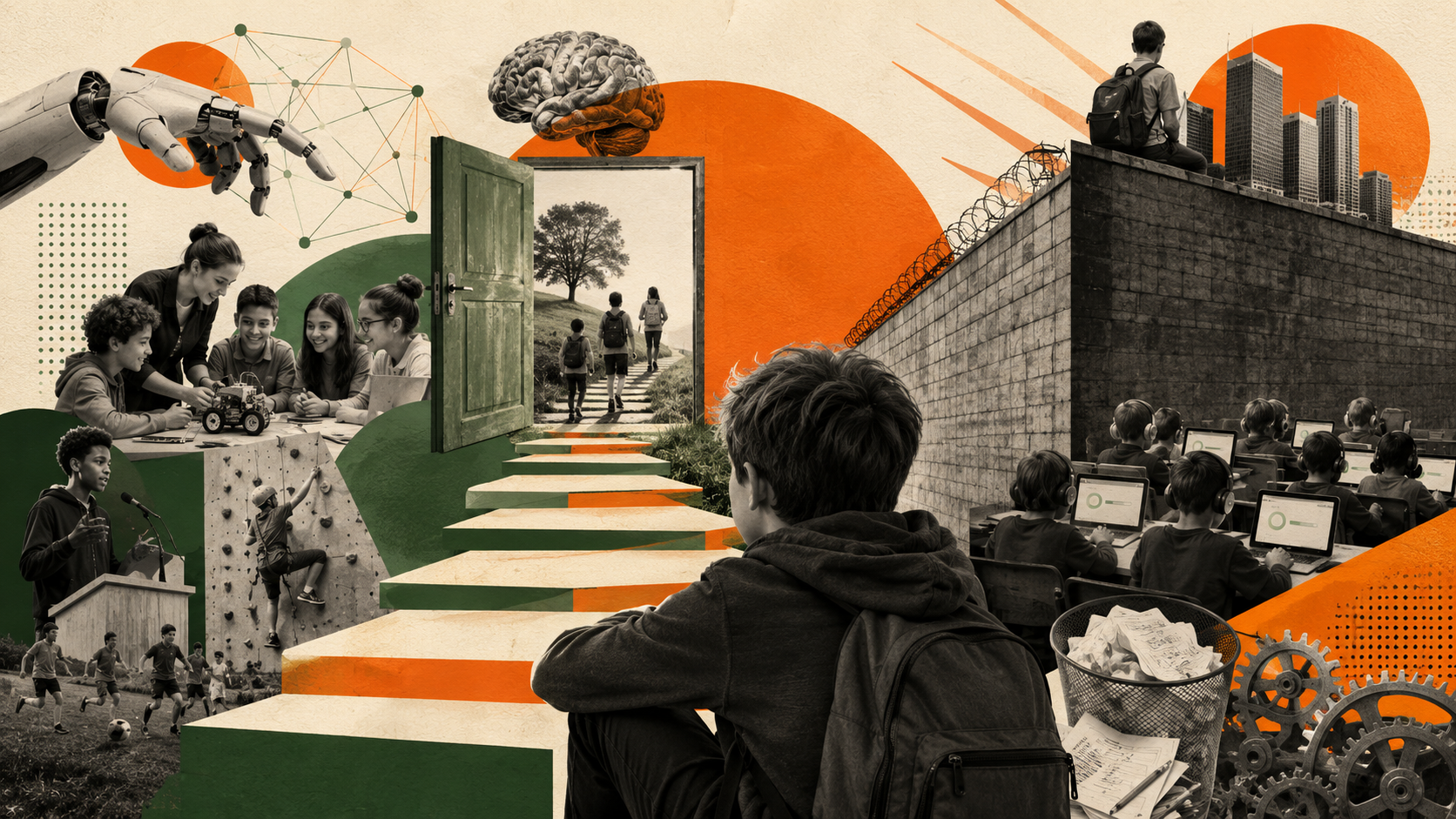
Wealthy children get the premium build. AI for personalised academics, small-group coaching, real projects, outdoor challenge, and adults with time to mentor them. Everyone else gets the budget build. AI as a screen babysitter, fewer adults, more dashboards, a narrower curriculum, and the word "personalisation" used to justify spending less on them. The affluent quietly top up at home. The rest are told automation is the same thing as attention.
And it can fail in either direction, which is the part I most want people to hold onto. One version hands AI to the children we have decided are cheap to teach and reserves a real human teacher for the families who can pay for one. The mirror image is just as plausible: the genuinely powerful AI tools get ring-fenced behind a seventy five thousand dollar gate while everyone else makes do with whatever free tier the budget will stretch to. The label changes but the disease does not. Whatever turns out to be the valuable part, the human or the software, drifts towards the children who were already ahead. So the question is never just whether AI is in the classroom. It is which children get the good version of it, and which get fobbed off with the cheap one.
The technology is not the villain in that story. The distribution model is. If AI makes education cheaper and the saved value is pocketed instead of reinvested in children, we have not built a better school. We have built a more efficient sorting machine, and it produces beautiful charts while the child it failed becomes a missing data point.
There is a quieter version of the same risk inside even a well-funded Alpha. A system can personalise the work and still flatten the child. The dashboard knows a student is stuck on fractions. It does not know the housing is unstable, or that the kid is masking anxiety, or that constant mastery tracking is slowly teaching a nine year old that they are permanently behind. A computer can never be held accountable for that, which is exactly why a human has to be. Measurement can support a child or it can manage them, and that difference is everything.
And this is not just an American problem
It is tempting to read all this as a story about the United States, with its seventy five thousand dollar schools and its private-by-default culture. Do not let us off that easily. We are heading for the same fork, just through different doors. England has a SEND system in crisis, schools buying EdTech with very little scrutiny of what the software actually does to a child, and a Department for Education now issuing guidance on AI in the classroom. The pupils most likely to be handed a screen and least likely to get the extra human attention are the same disadvantaged children the pupil premium exists to protect. If AI in our schools becomes a way to save money on the children we find expensive to teach, we will have imported the worst version of this without ever opening an Alpha.
The honest answer, and the fix
So, is this the future of education?
The design principle is right and I will defend it. Compress what machines do well, protect and expand what only humans do, and stop running children through a one-size factory line. If that is what people mean by the future of education, then yes, and it is overdue.
There is also the question of whether the headline even holds. Most of the eye-catching numbers come from Alpha itself, measured on an intake that selected for motivated, well-resourced families, which is exactly the group you would expect to do well anywhere. And the model has not had an easy year under scrutiny. Investigations by WIRED and 404 Media, drawing on former staff, parents and leaked internal documents, reported AI lesson plans flagged internally as sometimes doing more harm than good, heavy metric-driven pressure on children, and that most of the "guides" in one year were remote contractors rather than qualified teachers. Alpha disputes the critical coverage, so I am not treating it as settled. But it is a long way from the clean story the tours tell, and it is the gap between an interesting private experiment and something proven enough to build public policy on. [12]
But Alpha as it currently exists is not that future. It is a high-priced prototype of it, available mostly to families who were always going to be fine. As a private experiment that is legitimate, because families opt in. As a model for public education it has not earned the claim yet. I would want to see outcomes broken down by disability, prior attainment and background, not just headline growth figures. I would want retention data showing who leaves and why, wellbeing data and not only attainment, evidence the curriculum is broad rather than just software-friendly, and proof the model works for the children whose families cannot quietly supplement it. That is not hostility. That is the minimum bar before anyone scales it with public money. Regulators are already drawing that line. Pennsylvania rejected a cyber-charter built on the same two-hour AI model with adults recast as guides, on the grounds that it was untested, did not show alignment to state academic standards, and raised real concerns about special-needs students, and I think that caution was correct. [10]
The fix is not to make Alpha cheaper and hope. The fix is structural. The human-centred part of education, the afternoon that actually shapes a person, cannot be allowed to become the premium tier. It is the point of the whole thing, so it is the part we should fund publicly and protect first, not sell as an upgrade to the families who can already afford everything else. The fuller version of that argument, including how we pay for it, is one I have made in the care dividend. [11]
If you want something to do with all this, it comes down to a few questions, and they are the same whether you are a parent, a school leader or someone writing policy. When the software flags a child as behind, who is paid to look at why, and do they have the time to do it properly? Is the human layer, the coaching, the pastoral care, the actually-seeing-the-child, written into the budget, or is it the first thing cut when money is tight? And who does the model serve worst, and what is the plan for them? If a school cannot answer those, the technology is not the thing to worry about. The answers are.
The promise of AI in school was never that it could replace the human parts. The promise is that it might finally give us a reason to prioritise them. Alpha makes that possibility visible. It also shows how fast it could harden into another class divide. The real question is not whether Alpha works. It is who gets access to the parts of it that matter most, and whether we are willing to pay to give those parts to everyone.
Sources
[1] Alpha School, The Program and The two-hour school day. The two-hour model, AI tutoring, 90 percent mastery gates, the "guides" role, the afternoon life-skills workshops, and the claim of roughly double the academic growth with top-percentile results are Alpha's own descriptions.
[2] World Economic Forum, The Future of Jobs Report 2025. Analytical thinking, creative thinking, resilience, curiosity and lifelong learning, and leadership and social influence rank among the most important and fastest-rising skills for employers.
[3] OECD, Skills Outlook 2025. Social and emotional skills are largely teachable and are associated with academic success, employment, mental health and civic engagement.
[4] Ken Robinson, "Do schools kill creativity?" (TED, 2006), Ken Robinson on Wikiquote. "Human communities depend upon a diversity of talent, not a singular conception of ability."
[5] Education Endowment Foundation, Individualised instruction. Around plus four months in secondary schools and plus three in primary, with wide variation, and the note that it works better as a supplement to good teaching than as a replacement.
[6] Alpha School, Locations and the Alpha School Wikipedia entry, which reports in-person tuition ranging from 10,000 to 75,000 dollars per student, with most campuses around 40,000, Brownsville at 10,000 and New York at 65,000.
[7] US Census Bureau, Income in the United States: 2024. Real median household income was 83,730 dollars in 2024.
[8] Pew Research Center, US public, private and charter schools in 5 charts. Private school enrolment is highest among upper-income families.
[9] Education Next, Who Goes to Private School?. The middle-income share of private school enrolment has fallen by almost half over fifty years while the rate for wealthy children has held steady.
[10] Chalkbeat, Pennsylvania rejects AI cyber charter school. The state denied the Unbound Academy application, which used the same two-hour AI model with teachers recast as guides, calling the instructional model untested and citing standards alignment and special-education concerns.
[11] Jamie Bykov-Brett, The Care Dividend: turning AI productivity into social infrastructure.
[12] WBUR Here and Now, Investigation finds faulty lesson plans and unhappy students at an AI-powered private school, reporting on investigations by WIRED (October 2025) and 404 Media (February 2026). Alpha disputes the critical reporting.
Jamie Bykov-Brett
Listed as one of Engatica's World's Top 200 Business and Technology Innovators, Jamie is an AI and automation consultant who helps organisations move from curiosity to confident daily use. As founder of Bykov-Brett Enterprises and co-founder of the Executive AI Institute, he designs AI upskilling programmes that have delivered 86% daily adoption rates and a 9.7/10 NPS. His work sits at the intersection of technology implementation and human development, with a focus on responsible governance, practical tooling, and making AI accessible to every level of an organisation.
Get AI Insights Delivered
Practical perspectives on AI adoption and the future of work. No spam.