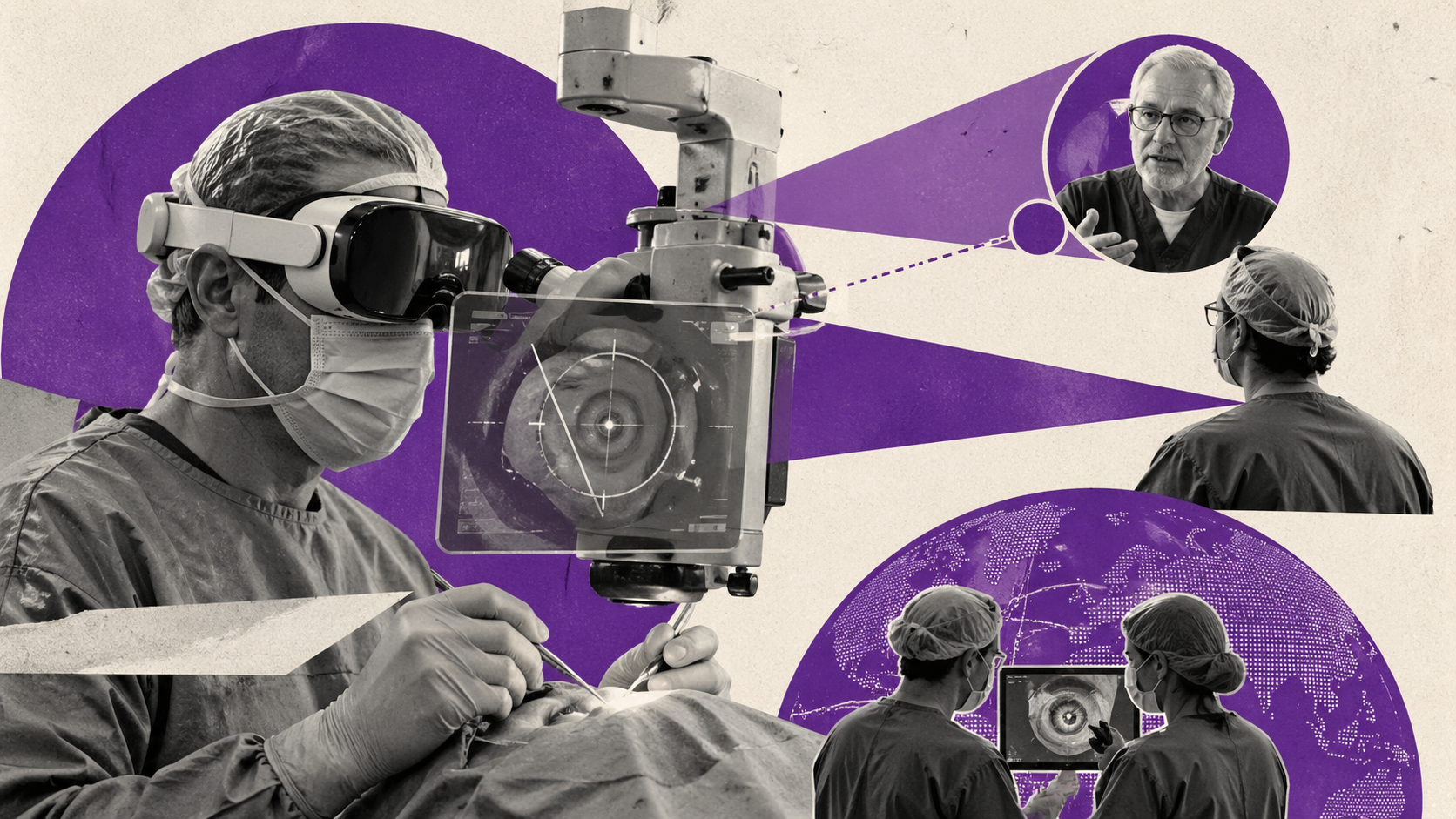
A New York eye surgeon has spent the last six months doing something quietly remarkable. Dr. Eric Rosenberg has performed hundreds of cataract operations wearing an Apple Vision Pro, streaming the view from a 3D digital microscope into the headset and overlaying the patient's pre-op scans on top of the live surgical field. The first procedure was in October 2025. He has not stopped since.
That is interesting on its own. What makes it more interesting is the context. Apple's spatial computing experiment has, by most measures, struggled. The device starts at $3,499, the form factor is bulky, and reporting suggests the next generation has been quietly shelved while the company pivots to lightweight glasses. And yet here is a surgeon doing the most delicate work imaginable, in volume, with the thing strapped to his face.
The reason is worth sitting with, because it tells us something useful about where head-mounted displays actually belong, and where they probably never will.
The substitute matters more than the device
Cataract surgery has, for decades, involved a surgeon hunched over a fixed optical microscope while glancing across the room at a separate monitor showing diagnostic data. Your neck does what it has to. Your eyes context-switch between the operative field and the screen with the measurements on it. Trainees in the room see a flat 2D version of what the surgeon sees in stereoscopic 3D, which is a meaningful loss when the whole craft depends on depth.
A Vision Pro running ScopeXR collapses that arrangement. The surgeon sees the operative field in 3D and the patient data layered on top, in the same line of sight, without moving their head. Rosenberg's claim, in the company release, is that the platform lets surgeons "virtually join procedures and see exactly what the operating surgeon sees", which means a senior colleague in another timezone can talk a resident through a complication in real time.
The headset is not winning here because it is a brilliant headset. It is winning because the thing it replaces, a fixed microscope plus a monitor stack plus a trainee craning to see, is genuinely worse for the job.
A useful prompt for healthcare and higher education leaders
If you run a hospital, a teaching trust, a medical school, or any institution where high-skill workflows currently involve people contorting themselves around screens, this story is a prompt rather than a product recommendation.
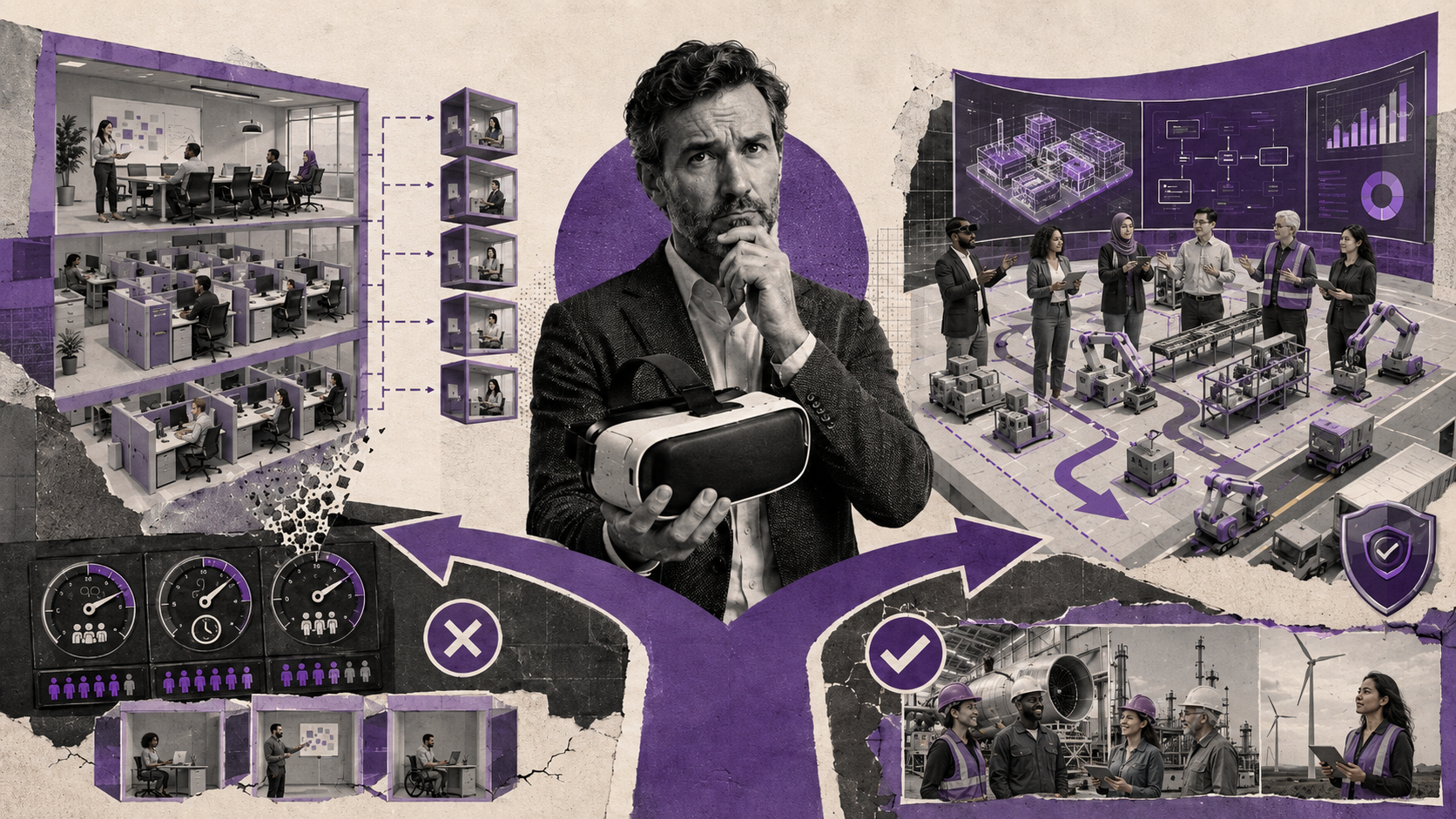
The question is not "should we buy headsets". The question is: where in our operations does someone currently switch context between three screens, a paper chart and a person, and lose accuracy or time doing it? That is the workflow where spatial computing might pay back its cost. Almost every other application is a hobby project dressed up as a strategy.
I have spent enough time inside transformation programmes to know how this usually goes wrong. A leadership team sees a striking demo, buys the kit, hands it to a willing department, and waits for ROI that never arrives because the underlying work was already fine on a normal monitor. The headset becomes a shelf ornament, and the next vendor through the door has a harder sell. If you want a more disciplined way to think through these calls, our AI leadership roadmap walks through the same logic for adjacent decisions: start with the workflow, not the device.
What the cataract case actually proves
Three things, roughly.
One: enterprise beats consumer for this category, for now. Apple's pivot away from heavyweight headsets and towards glasses is a tacit admission that the mass market is not there. The medical, aviation training and industrial design users are.
Two: the value is in collaboration, not just visualisation. Rosenberg's framing is about bringing expertise into rooms that did not previously have it. A resident in a regional hospital with a senior surgeon watching their hands. That is a training and equity argument as much as a clinical one, and it is the part that should interest medical schools.
Three: the test is the substitute. If the alternative to the headset is a perfectly good laptop, the headset loses. If the alternative is a tower of monitors, a paper chart and a phone call to a colleague three states away, the headset has a real chance.
One thing to try this week: pick the single most physically awkward workflow in your organisation, the one where someone is visibly juggling screens, paper or people, and ask whether the problem is the work or the arrangement of tools around it. Most of the time it is the arrangement. Sometimes a headset is the answer. Usually it is not. Knowing the difference is the actual skill.
.png?width=783&height=479&name=BBE%20Logo%20Teal%20Background%20(1).png "Bykov-Brett Logo")
 Jamie Bykov-Brett
·
29 April 2026
·
5 min read
Jamie Bykov-Brett
·
29 April 2026
·
5 min read