.png?width=783&height=479&name=BBE%20Logo%20Teal%20Background%20(1).png "Bykov-Brett Logo")
Why “Soft” Skills Are Becoming Your Hardest Currency In The Age Of AI
 Jamie Bykov-Brett
·
23 February 2026
·
8 min read
Jamie Bykov-Brett
·
23 February 2026
·
8 min read
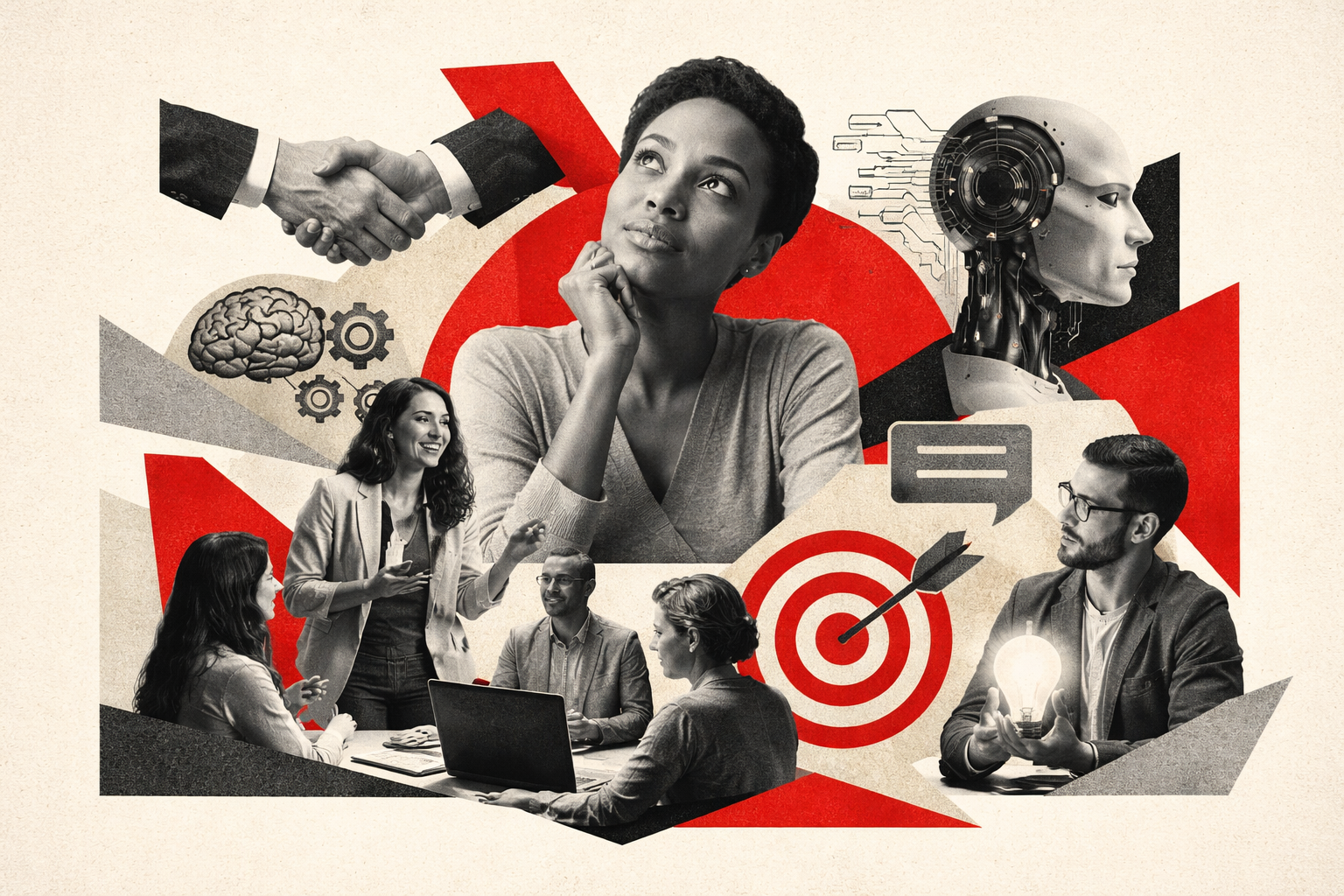
Somewhere in a boardroom last quarter, a CFO asked the classic question: "Are we investing enough in AI skills?"
The sharper question now is different:
"Are we investing enough in the skills AI cannot copy?"
Because the data is increasingly clear. As AI races ahead, the economic value of deeply human skills is not just holding up, it is accelerating.
Welcome to the human-centric skills revolution.
The 180-degree value flip
For most of the industrial era, we rewarded people for being predictable, repeatable, optimisable. The closer you behaved to a machine, the more you were paid.
In an AI-rich world, that logic flips. Machines now handle what is:
- Routine
- Rules-based
- Repetitive
What rises in value is everything that is:
- Creative
- Relational
- Context-sensitive
- Emotionally intelligent
Automation risk maps cleanly to this split:
- Creative, care, and management roles face very low automation risk, often under 20%
- Routine and clerical roles frequently sit in the 70-85% risk band
If your work relies on being human with other humans, you are far safer than the spreadsheet warriors.
The new growth engines of the economy
Follow the money. Human-centric sectors are outpacing traditional ones (traditional manufacturing at −1.2%, and the overall UK economy at 4.5%):
- Creative industries outgrow the wider economy (9%)
- The care economy expands faster than manufacturing (6.5%)
- Artisan and handicraft markets surge globally (10.5%)
These are not "nice" side stories. They are growth engines.
Unpaid care work alone is worth hundreds of billions per year once you actually price it. Zoom out to the global care economy and you are looking at trillions in value.
AI should be forcing us to count it. We have to build an economic architecture on top of work we have historically refused to count.
The half-life problem: why tech skills age faster than humans do
Technical skills still matter, a lot. You would not want a surgeon who has not updated their methods since 2003, or a CTO who thinks "cloud" is a passing fad.
But the half-life of technical skills has collapsed:
- In the 1980s: roughly 10 years
- Today: closer to 4 years
- Soon: projected to drop below 2 years
A "hard" skill you proudly add to your CV this year can be half obsolete before your next performance review cycle.
What does not depreciate at the same speed:
- Learning agility
- Curiosity
- Adaptability
- Communication
- Emotional intelligence
These human capabilities are what let leaders and teams ride the wave, rather than chase it.
Public policy: protect people, not jobs
There is a principle that I believe should anchor any serious policy conversation about AI: protect people, not jobs. Jobs will evolve, tasks will shift, whole categories will be reconfigured. That is not the problem, the problem is failing to give people the stability, time, and confidence to adapt as work changes around them.
This is where we need to be far bolder. Policy makers should treat income security as an enabler of growth, not a concession. A modern safety net, potentially including forms of universal basic income, would give people the foundation to retrain, move sectors, build new skills, or start new ventures without the fear of falling through the cracks.
The priority should be human mobility, not job preservation. That means:
- Ensuring baseline financial security so people can adapt rather than freeze
- Funding lifelong learning routes that move with the speed of technology
- Creating incentives for organisations that use AI to upgrade human work, not simply erase it
- Recognising that human-centric skills compound in value when people have space to develop them
If we cling to protecting the jobs of yesterday, we slow the economy of tomorrow. But if we protect people directly, we create the conditions for a labour market that evolves without leaving anyone behind. AI should widen human possibility, and that only happens when the foundations underneath people are stable enough to let them move.
Employers have moved. Education has not caught up.
There is a growing gap between what employers value and what traditional education consistently delivers.
Well over 90% of employers now rank "soft" skills, though I have to admit I hate that term; I think they are better described as essential skills, above technical expertise. Yet only around half of graduates show the level of soft skills employers actually expect.
The market is screaming for collaboration, empathy, critical thinking, and real-world communication. Yet most talent pipelines are still calibrated for exams, not complex interpersonal problem-solving in AI-augmented environments.
For executive teams, this is not just a "social good" issue, it is a strategic risk:
- Where will your next layer of human-centric leaders come from?
- How will you nurture them faster than AI reshapes your operating model?
The hidden premium on emotional intelligence
Individuals with high emotional intelligence now earn a clear wage premium, often tens of thousands more per year.
That is not sentimentality. It is economics:
- High-EQ managers reduce friction and turnover
- They increase psychological safety, which boosts innovation
- They manage complex stakeholder landscapes that AI cannot safely navigate alone
In an AI era, the cost of poor judgement or poor empathy multiplies. The premium for those who get it right multiplies too.
What this means for leadership in practice
If you are leading a business into an AI-heavy future, this value shift has direct implications for your agenda.
1. Reframe "AI strategy" as "human-plus-AI strategy"
The question is not: "What can we automate?" It becomes: "What do we want humans uniquely focused on, and how do we surround them with AI tools that augment human capability and amplify that value?"
The recent wave of organisational announcements declaring "we are pivoting to an AI-first organisation" misses the point. It misunderstands what AI is good at, and it misunderstands the changing nature of the workforce. Your organisation is not forward-thinking or edgy simply because you bolt AI onto everything. The real signal of progress is whether you create a culture that protects human judgement, invests in human creativity, and builds AI around people to enable them to achieve new heights.
2. Put human-centric skills into your P&L assumptions
These are not fluffy concepts. They are economic levers:
- Better EQ in managers → lower attrition and rehire costs
- Better collaboration skills → fewer failed projects
- Better creative problem-solving → higher ROI on AI investments
If you are modelling AI ROI without explicit behavioural and cultural assumptions, you are flying partially blind.
3. Treat reskilling as a permanent rhythm, not a one-off project
With a large share of current worker skills set to be obsolete by 2030, one-and-done training days will not cut it. You need:
- Ongoing micro-learning
- Coaching that addresses both tech and mindset
- Deliberate practice for human-centric skills, not just tools
Human-centric leadership development pays off most when it is embedded in how you work, not just how you attend workshops.
How we help leaders navigate this shift
At EAII, the mission is simple to state and hard to fake: help senior leaders lead their organisations into the AI era, without losing the humans in the process.
The "secret sauce":
- World-class leadership psychology
- Deep technical mastery in AI and emerging tech
- A relationship-first approach where trust beats transactions
In practice, that translates into:
All anchored in four pillars: ethics, trust, cultural inclusion, and measurable impact.
Questions for your next exec discussion
If you want to turn this from "interesting" into "operational", take these straight into your next leadership meeting:
- Where in our organisation is uniquely human work already creating outsized value, and how could AI amplify it?
- Which critical roles depend on creativity, care, judgement, or relationship building, and how are we developing those people?
- How much of our AI budget is earmarked for human skills, culture, and change support, not just technology?
- What would it look like if we reported on human-centric skills as a strategic asset, not a side note in HR?
The human-centric skills revolution is not on the horizon, it is here. The organisations that thrive will not be the most automated.
They will be the ones most intentional about what only humans can do, then design everything else around that.
Jamie Bykov-Brett
Listed as one of Engatica's World's Top 200 Business and Technology Innovators, Jamie is an AI and automation consultant who helps organisations move from curiosity to confident daily use. As founder of Bykov-Brett Enterprises and co-founder of the Executive AI Institute, he designs AI upskilling programmes that have delivered 86% daily adoption rates and a 9.7/10 NPS. His work sits at the intersection of technology implementation and human development, with a focus on responsible governance, practical tooling, and making AI accessible to every level of an organisation.
Get AI Insights Delivered
Practical perspectives on AI adoption and the future of work. No spam.