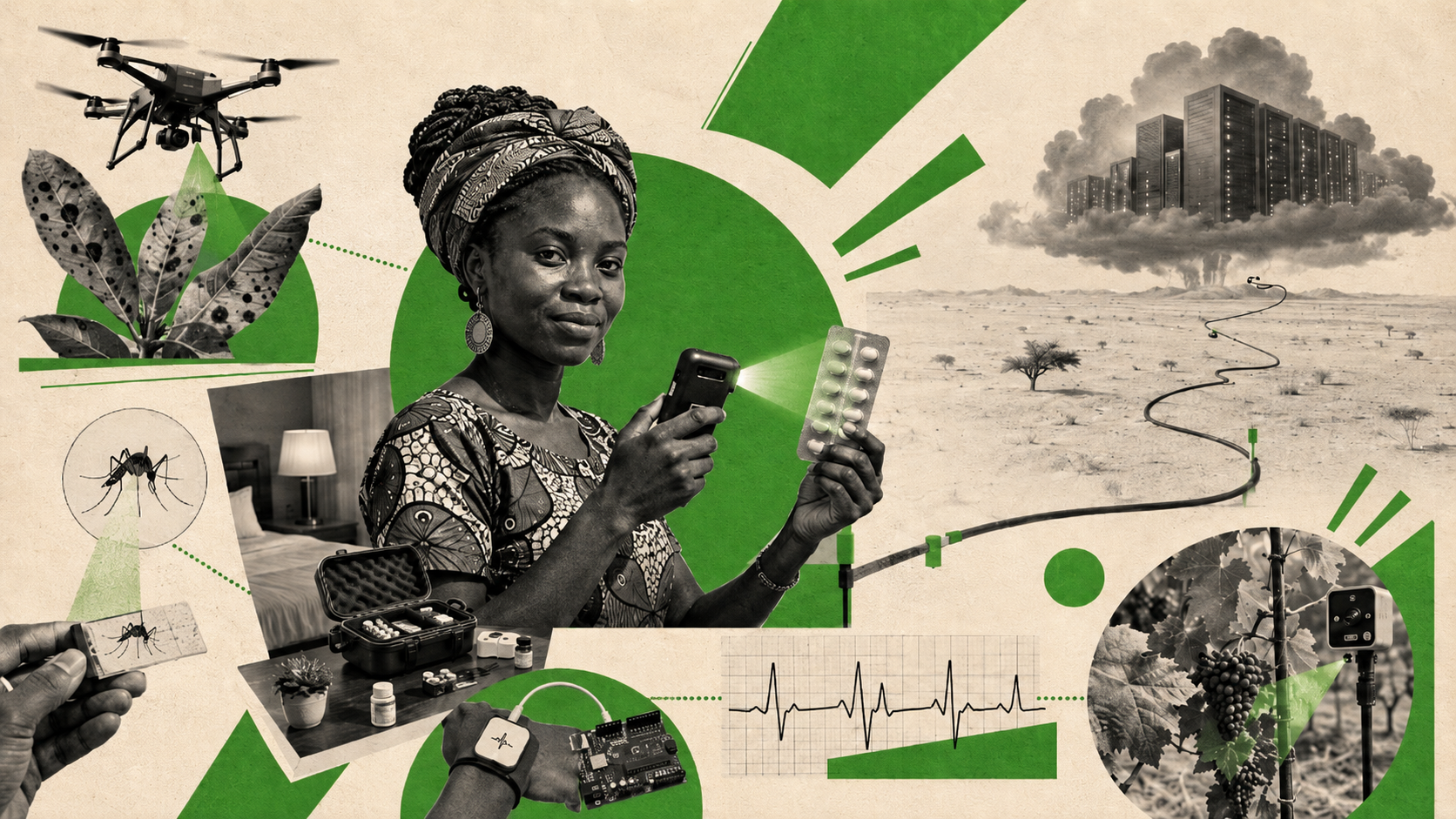
One morning in 2019, Adebayo Alonge stood in a Cape Town hotel room, ready to show off a device that could spot fake medicine. His RxScanner reads a pill with infrared light, works out its molecular fingerprint, and checks that against a drug database to say whether the medication is genuine or a counterfeit. Counterfeit drugs kill thousands of people across Africa every year, so this is not a party trick. Pharmacies in more than a dozen countries were already using it. And that morning, in front of the people he most needed to impress, it stopped working.
The reason had nothing to do with the chemistry. The scanner did its job. The problem was that the AI it relied on lived on a server in the United States, roughly 14,000 kilometres away, and the local internet was slow. As Alonge tells IEEE Spectrum, a single scan was taking over five minutes to come back. So he asked his engineers to do something drastic: strip the model down to a small, low-power version that could run entirely on an Android phone, with no connection at all. They had it working in two hours.
It saved the demo, and it changed how he saw the whole field.
That shrunken model is what people now call small AI, and it is a world away from the enormous systems that dominate the headlines. The big models need vast data centres, huge amounts of electricity, mountains of data, and skilled teams to run them. Small AI does the opposite. It trains a compact model on one specific problem and runs it on cheap hardware, often a device you could hold in your hand.
Here is the part that should give any leader pause. For most of the planet, the giant models are not the story at all. A November World Bank report found that only 0.7 percent of internet users in the world's poorest countries have used ChatGPT, compared with a quarter of internet users in the richest nations. Ajay Banga, the World Bank's president, made the point plainly at Davos: outside the developed world, and perhaps India and China, very few countries have the combination of computing power, electricity, data, and expertise that big AI demands. Small AI can still deliver useful, sometimes life-saving services to those places.
And it already is. In India, a drone photographs cashew plants and identifies diseased ones from the tell-tale splotches on their leaves, doing all the processing on the drone itself with no server involved. Other small models spot ant infestations in a Uruguayan vineyard, detect malaria-carrying mosquitoes, and run electrocardiograms from a simple Arduino board in parts of Brazil that cannot get hold of proper hospital kit. Marcelo José Rovai, a Brazilian professor who worked on several of these projects, calls this the most important area in AI today, and says it is growing fast.
I find this reframing more honest than most of what gets said about AI. We have been taught to equate advanced with big, and capable with expensive. The lesson from a phone diagnosing counterfeit pills in a place with patchy electricity is the reverse. The winning system was not the most powerful one. It was the one that fit the problem, the place, and the person using it. That is a judgement call, not a compute problem, and judgement is exactly the thing that does not come in a bigger box.
For senior leaders, the practical takeaway is uncomfortable but freeing. You probably do not need the largest, priciest model to solve the problem in front of you. You need a clear definition of that problem, and the capability inside your team to build or fine-tune something small that actually addresses it. The organisations that pull ahead will not be the ones that spent the most on frontier tools. They will be the ones that got specific.
Alonge puts his bet this way: the future is not one giant model at the centre, but millions of small, precise models at the edge, each solving one problem in one context. He also argues the giants may not stay affordable, and that if nobody is subsidising them, most people simply will not be able to use them. Worth remembering the next time someone tells you AI only counts when it is enormous.
Frequently Asked Questions
What is small AI and how is it different from a large language model?
Small AI refers to compact models trained for one specific task that can run on cheap, low-power devices, often without an internet connection. Unlike large language models, which need data centres, heavy electricity, and huge datasets, a small model does one job well on hardware as modest as a phone or an Arduino board. The trade-off is narrow focus for far lower cost and complexity.
Why did Adebayo Alonge's RxScanner fail during the Cape Town demo?
The RxScanner failed because its AI model was hosted on a server in the United States, about 14,000 kilometres away, and local bandwidth was too limited to return a result in reasonable time. A single scan took over five minutes. The scanner itself worked fine. The fix was to shrink the model so it could run entirely on an Android phone with no connection.
Does small AI actually work for serious problems, or just simple tasks?
Small AI is already handling high-stakes work. Examples from the source include authenticating medicines to catch dangerous counterfeits, identifying diseased cashew plants from drone photos in India, detecting malaria-carrying mosquitoes, and running electrocardiograms from a basic Arduino device in parts of Brazil that lack proper hospital equipment. These are life-affecting tasks solved with compact, specific models rather than giant systems.
Why should business leaders care about small AI if they have the budget for big models?
Because the biggest model is often the wrong tool. The lesson from small AI is that the system which fits the problem, the setting, and the user tends to win, regardless of its size. Leaders who define their problem precisely and build the in-house capability to create or fine-tune a small model can solve it more cheaply and reliably than those who simply buy the largest available system.
Is small AI just a temporary workaround for poorer regions?
No, its advocates see it as a durable direction for AI, not a stopgap. Adebayo Alonge argues the future is millions of small, precise models running at the edge, each solving one problem in one context. He also warns that frontier models may become too costly for most users without subsidy, which would make affordable, task-specific small models the form of AI that touches the most lives over time.
.png?width=783&height=479&name=BBE%20Logo%20Teal%20Background%20(1).png "Bykov-Brett Logo")
 Jamie Bykov-Brett
·
07 July 2026
·
6 min read
Jamie Bykov-Brett
·
07 July 2026
·
6 min read