Let's talk about Virtual Reality onboarding and pre-boarding.
In 2013, I was reading through Deloitte's Human Capital Trends Report when I came across a prediction: "In seven years, half of your workforce will be working elsewhere." At the time, my only experience of remote working had been using a tablet too slow to load my calendar, so unreliable I'd resort to pen and paper until I could get back to the office. I would have heavily betted against that prediction. Yet by early 2020, Deloitte's forecast proved spookily accurate, exposing just how ill-prepared a large percentage of organisations were to rely on a remote workforce.
After seven months in lockdown, many organisations began reviewing their internal processes and planning for the future. That planning will inevitably involve evolving onboarding to accommodate a remote workforce.
Even before Covid, the numbers told a troubling story, only 12% of employees strongly agreed that their organisation does a great job of onboarding (Gallup), almost a third of new hires start job-searching within the first six months (Harver), and the average cost of a new hire in the UK is £3,000 before they've walked through the door (Workplaceon). Despite this, many organisations still lack a formal onboarding process, and many that have one don't do it well. Good onboarding sets an employee up to succeed, yet it frequently contends with stretched managers who treat it as something to circumvent in order to get their new hire straight into the action. The damage to reputation, trust, and the bottom line is staggering.
So what does the future of onboarding look like when most current processes depend on physical presence? The answer, in my view, is Virtual Reality pre-boarding.
Let me help you imagine the experience.
Your organisation is hiring a new employee and:
- They are one of the 81% of new hires who want to receive details about their new role at the pre-boarding stage (Tydy).
- They work remotely.
- They can't visit the office, due to Covid, accessibility requirements, or prior arrangements.
Now imagine this employee's pre-boarding experience.
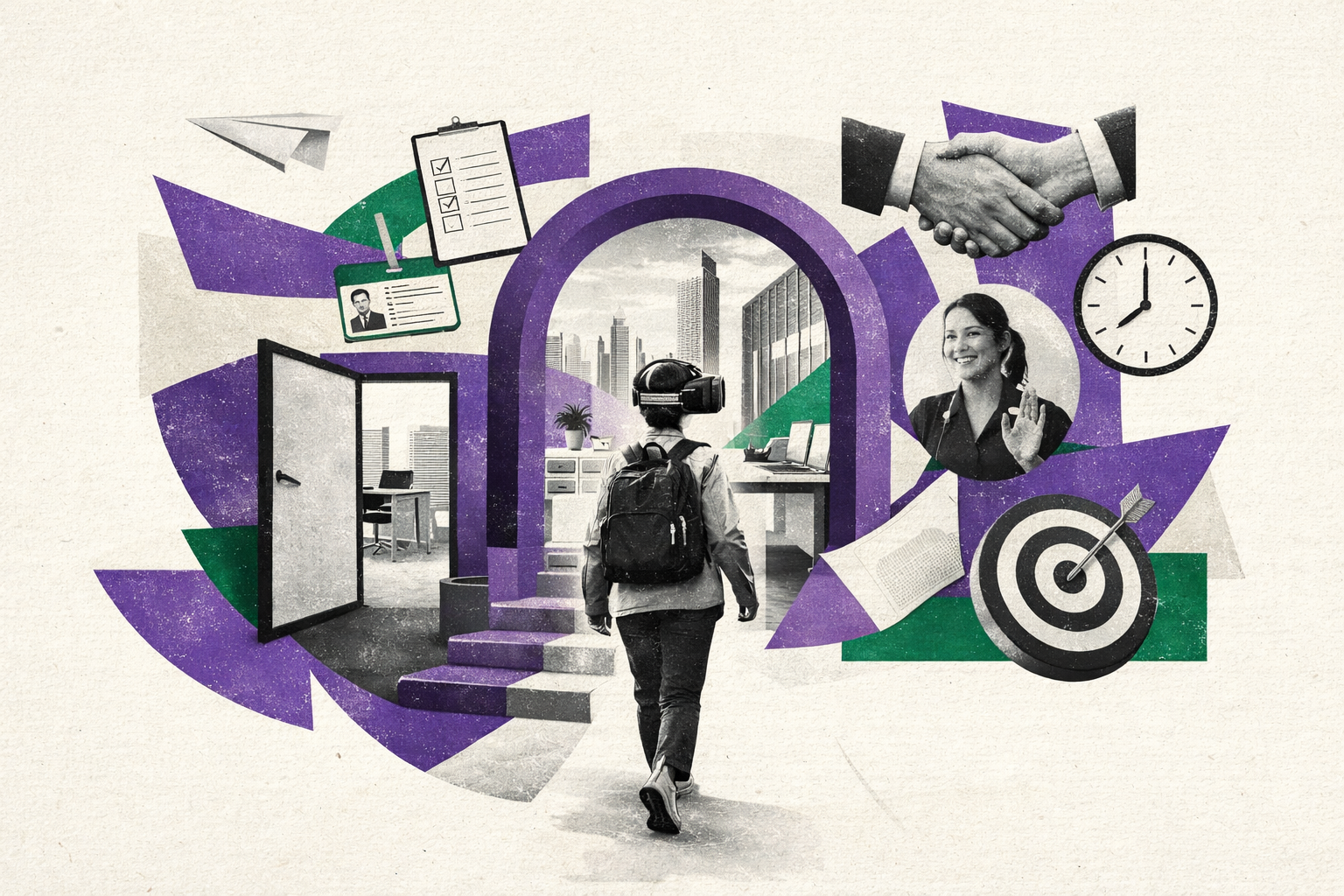
Prior to their first day, the employee receives a Virtual Reality headset with your organisation's onboarding package pre-loaded. They can virtually tour their new office, access orientation training pre-recorded in 360-degree video, and complete introductory paperwork digitally, all before walking through the front door. They could even "meet" the CEO and senior management team in a virtual meeting.
This allows large portions of the onboarding process to be digitised and automated, freeing up time, resources, and energy for the parts that can't be. Think of how many staff hours you could reclaim that would otherwise be spent on orientation delivered before someone has even started.
It's comparatively cheap and not overly time-intensive to set up. Consider the cost relative to:
- Turnover from staff who've had a poor onboarding experience.
- Staff hours spent delivering orientation training.
- Re-recruitment costs when new hires accept an offer but don't start.
What's the business case?
- Many onboarding tasks can be accomplished during the pre-boarding process.
- The goal is to make your new employee feel engaged, introduce them to the company culture, and reduce uncertainty so they arrive on day one excited and ready.
- Poor onboarding has a significant impact on your bottom line, companies that leave onboarding to chance see 50% retention rates for new talent (Criterion).
- Your pre-boarding process directly affects the loyalty a new employee feels towards your company. With the right communication and outreach, you can generate rapport from the get-go.
- Pre-boarding supports employees to hit the ground running.
- A great onboarding programme can increase staff retention by as much as 82% (Glassdoor).
- Employees engaged prior to their first day are far more likely to actually start, saving thousands in re-recruitment costs.
- The growing trend of remote working, compounded by Covid-19, means it's increasingly common for an employee not to visit the office on day one. Pre-boarding helps them transition into their new workplace and feel part of the organisation from the outset.
- According to an Aberdeen Group study, companies with a pre-boarding process are 11% more likely to retain first-year employees than those without.
So, why am I telling you this?
I have years of experience developing regional and global onboarding processes for a global philanthropic organisation, alongside my work as a Virtual Reality developer. I'm looking for an individual or organisation interested in commissioning Beyond XR to build a VR pre-boarding package, which I plan to use as a proof of concept to demonstrate the potential of VR pre-boarding to other organisations.
Sound interesting? Get in touch at [email protected] to connect.
.png?width=783&height=479&name=BBE%20Logo%20Teal%20Background%20(1).png "Bykov-Brett Logo")
 Jamie Bykov-Brett
·
16 September 2020
·
5 min read
Jamie Bykov-Brett
·
16 September 2020
·
5 min read