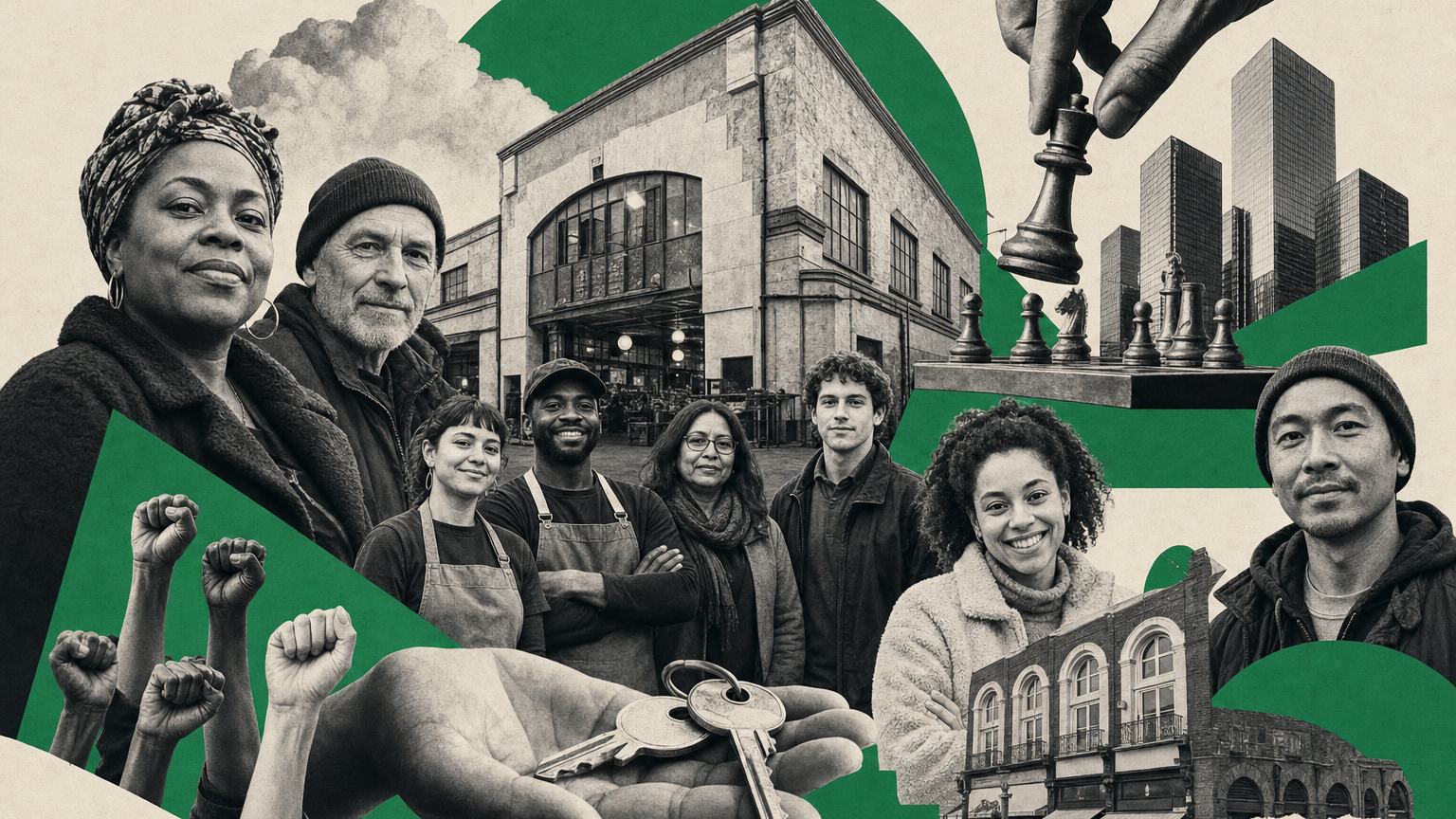
You often can see the shape of this story before anyone tells you the ending.
A beloved market, a parade of independent traders, a freeholder ready to sell, and a queue of investment vehicles with spreadsheets that treat the whole thing as a yield. The community group turns up with a crowdfunder and a lot of heart. Everyone wishes them well. Normally, the property fund wins.
Except in Brixton, it didn't. Buy Back Brixton won the buyer bid for Brixton Village, as Retail Gazette reported, & the campaign is now the party at the table.
I want to be careful here, because the easy reading is the wrong one. The easy reading calls this a feel-good triumph cooperatives and passion over capital. Passion loses to capital roughly 99.99% of the time. What happened is duller & far more useful: a group of residents did the thing property buyers do, & did it well enough to be taken seriously as a counterparty.
What a seller actually wants is certainty. They want a bidder who will not vanish at week six, whose funds are where they say they are, whose decision-making does not require a fresh public meeting every time a clause changes. Most community bids fail on that last point long before they fail on price. A campaign with a thousand supporters & no mandate is, from the seller's side of the table, a thousand ways for the deal to collapse.
The hard work of a community buyout is building a structure that can say yes.
And this is the frustration I hear constantly from organisers: we can get the people, we can even get some of the money, but we cannot get taken seriously. The limiting belief underneath it is that community groups are structurally amateur, that there is a professionalism gap only money closes. I understand why that belief sticks.
It is also wrong, & Brixton is the evidence.
What reads as professionalism is mostly just a pre-agreed answer to the question "who is allowed to sign this?"
I have spent a chunk of this year on the other side of that gap. In July I wrote a 21-page pre-feasibility proposal for a community-led stewardship campus at Avery Hill Mansion & its Grade II listed Winter Garden in Greenwich, a glasshouse sitting on the Heritage at Risk register while a public park carries on around it. That document was about governance, phasing, who holds the asset & what happens if the money is short. A few things that make these kind of things uncomfortable to write: the campaign becomes credible at the exact moment it stops being a campaign & starts being an organisation.
Two things are true at once about that, & I'm not going to flatten either. Community ownership genuinely redistributes power, keeping a market in the hands of the traders & residents who made it worth buying. It also demands that a loose group of people accept delegated authority & the end of decision-by-consensus-of-whoever-showed-up. That is a real annoying cost, it's a high price to pay and it is paid by real people who liked the group better before. Pretending it is painless is how campaigns implode in month nine.
A market that a community has to buy back is a market that was sold out from under it in the first place. The win counts. So does the loss that came before it.
What transfers to your high street and community ownership is the sequencing. Sort your ownership mandate before you sort your fundraising. Agree, in writing, who can commit the group to a price & a timeline. Get that done while things are calm, because you will not get it done in a bidding window.
Brixton has the answers and it & won a market. The rest of us are still holding meetings. If you want to see what answering it properly looks like in practice, watch the people organising ownership street by street.
Frequently Asked Questions
What did Buy Back Brixton actually win?
Buy Back Brixton won the buyer bid for Brixton Village, as reported by Retail Gazette, which means the community campaign was selected as the purchaser ahead of competing bidders. Winning the bid is a stage in the process, since a selected buyer still has to complete the transaction, but it puts the campaign in the position of counterparty.
How can a community group outbid property investors?
Community groups win by offering certainty. Sellers care about whether a buyer can hold to a timeline & sign without reopening every decision. A group with delegated authority & clearly evidenced funds looks like a deal that completes, which is worth a great deal to a seller weighing several offers.
What is an ownership mandate?
An ownership mandate is a written agreement setting out who in your group is authorised to commit to a price & a timeline, & up to what limit. Without one, every negotiation stalls at the point where a decision is needed. Agree it while things are calm, because a live bidding window gives you no time to build consensus from scratch.
What is the biggest risk to a community buyout after the bid is won?
The biggest risk is the transition from campaign to organisation. Groups that thrive on open meetings & consensus often struggle with delegated authority & the formality a property transaction demands. That shift is a genuine cost to people who preferred the looser version of the group, & left unaddressed it is what pulls campaigns apart mid-process.
Does this approach work for buildings other than markets?
Yes, the governance mechanics apply to any contested community asset, from high street retail to heritage buildings. The Avery Hill Mansion & Winter Garden estate in Greenwich, a Grade II listed glasshouse on the Heritage at Risk register, needed the same work in its pre-feasibility stage: governance, phasing, who holds the asset & what happens if funding falls short. The questions are the same whatever the building happens to be.
.png?width=783&height=479&name=BBE%20Logo%20Teal%20Background%20(1).png "Bykov-Brett Logo")
 Jamie Bykov-Brett
·
14 September 2026
·
4 min read
Jamie Bykov-Brett
·
14 September 2026
·
4 min read