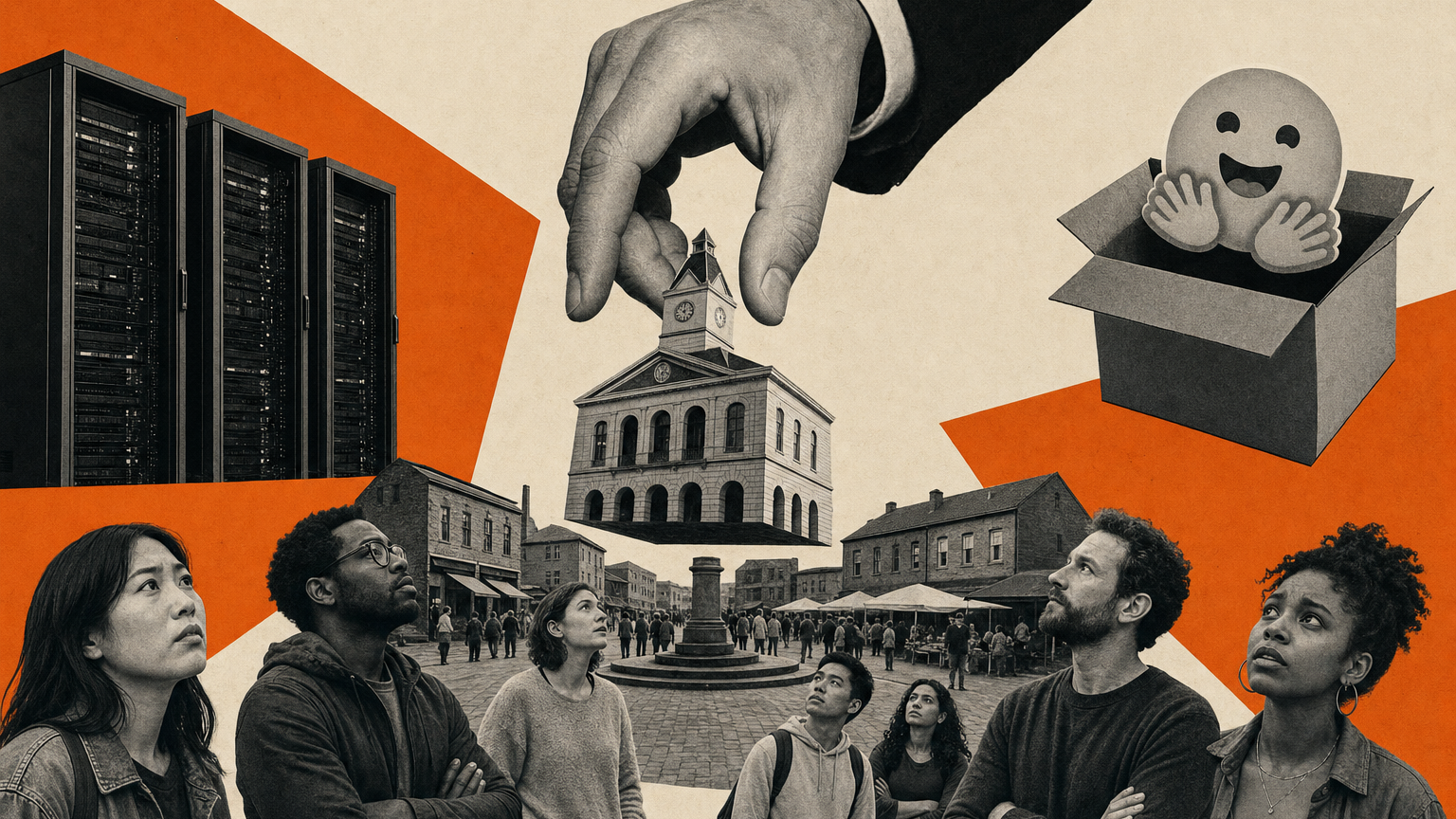
If you are anything like me, you have certainly downloaded a model from Hugging Face without thinking twice about who runs the joint.
Most people don't.
It works the way a public library works, think Google Drive for AI models: you show up, you browse, you take what you need. Tens of thousands of models sit there, uploaded by researchers, startups & large labs alike. It feels like shared infrastructure, one of those cool places that it felt like something nobody owned.
Well, a feeling can be different than the reality. Nvidia just bought it for $12.9 billion.
As reported by The Indian Express, the deal makes Nvidia the owner of what has become open-source AI's central distribution layer. Essentially, the platform where models & datasets live.
It changes what "open-source AI" means in practice.
Hugging Face is not a research lab. It does not compete with OpenAI or Anthropic on frontier models. BUT... it is the place where everyone, including OpenAI & Anthropic, publishes weights, shares benchmarks & lets the community kick the tyres, kick the engine etc. It is the registry, the repo, the commons. And now it belongs to the company that already controls most of the hardware those models run on.
This is a vertical integration play, pure & simple. Nvidia already owns the GPU layer.
With Hugging Face, it now owns the distribution layer too. If you are an enterprise buyer evaluating which foundation model to deploy, the company that sold you the compute is now also the company hosting the model zoo you are browsing. That is not a conspiracy. It is business logic that should make procurement teams ask harder questions about where their dependencies actually sit.
The tension is real, though. Hugging Face was burning cash. Running a platform at that scale, with free hosting for hundreds of thousands of models, is not cheap. The company needed either to charge more aggressively or to find a deep-pocketed owner. Nvidia is that owner, & Nvidia has every commercial reason to keep the platform popular. A thriving Hugging Face sells more GPUs. So the deal is a land-grab that concentrates control & probably the thing that keeps the lights on. Those two facts coexist, & pretending otherwise is comfortable but wrong.
CJ Trowbridge (who's TikToks I love) argued for this acquisition in his 2024 MBA thesis, two years before it happened. He reads the same facts as deliberate strategy rather than a rescue. Nvidia already runs two tiers on purpose: an enterprise line carrying an enormous markup, & a cheap line for people who are learning. A Jetson Nano costs about two hundred dollars & is engineered so that you cannot build a cluster out of them. That limit is a commercial decision wearing the clothes of a technical one.
On his reading, Hugging Face is the same design expressed in software. Free while you are learning, paid once you have clients. He calls it buying future customers, & his advice to Nvidia is to widen that gap: subsidise the beginner until the moment they start earning, charge the enterprise whatever the traffic will bear, & spend the difference on the next generation of silicon. He would go further still & have Nvidia rent out its own data centres, which would put the inference layer in the same hands as the other two.
His argument is worth sitting with, because it inverts the usual worry. Most people fear that an acquisition closes the on-ramp. Trowbridge thinks the on-ramp is the product, & that commercial self-interest guards it more reliably than any governance promise. If he is right, the free tier survives because it works as a funnel. That tells you a great deal about access & nothing at all about what happens on the day you want to leave.
Nvidia is not going to shut down open-source model hosting tomorrow. The concern for enterprise leaders is subtler: when one company controls the hardware, the distribution platform & the CUDA software stack, the switching costs become invisible until you try to switch. Every "open" model you download from a Nvidia-owned platform, optimised for Nvidia silicon, trained on Nvidia-rented clusters, is open in licence & locked in practice. The weight file is free. The infrastructure to run it is not.
For rival chipmakers like AMD & Intel, the acquisition is a direct threat. Hugging Face's optimisation tools, its inference endpoints, its default configurations all risk drifting toward Nvidia hardware first. For cloud providers building custom silicon, Google's TPUs, Amazon's Trainium, the question is whether the most popular model hub will stay a genuinely neutral venue or start favouring one vendor's stack.
I think this deal is the point where "open-source AI" splits into two distinct things: open-weight models, which remain freely downloadable, & open infrastructure, which is now largely corporate-owned. Within twelve months, I expect at least one major lab or consortium to launch a competing, foundation-funded model registry explicitly positioned as vendor-neutral. The signal to watch is whether the Linux Foundation or a similar body steps in with real money. If nobody does by late 2027, the window has probably closed, & Nvidia's grip on the distribution layer becomes the default.
I could be wrong if Hugging Face's community governance proves stronger than its new ownership structure. But governance without funding independence is a paper shield.
The deal is done. The question for leaders is whether to understand, properly, what sits beneath the tools they already depend on, the kind of clear-eyed infrastructure literacy that the AI Literacy Lab is built around.
Frequently Asked Questions
Why is Nvidia's acquisition of Hugging Face such a big deal?
Hugging Face is the central platform where most open-source AI models are shared, downloaded & benchmarked. Nvidia buying it means one company now controls both the dominant AI hardware (GPUs) & the main distribution hub for open-weight models. That vertical integration changes competitive dynamics for every lab, chipmaker & enterprise buyer in the AI supply chain.
Does this mean open-source AI models will stop being free?
No. Open-weight models will almost certainly remain freely downloadable. Nvidia has strong commercial reasons to keep Hugging Face popular, because a thriving model hub drives demand for its GPUs. The real concern is infrastructure lock-in: free model weights that only run efficiently on one vendor's hardware are open in name but constrained in practice.
How does this affect companies already using Hugging Face for AI development?
Enterprise teams should audit where their AI dependencies sit. If your models, optimisation tools & inference pipelines all run through a single vendor's ecosystem, your switching costs are higher than they appear. The acquisition does not change anything overnight, but it should prompt procurement & engineering teams to map their full dependency chain from silicon to serving.
What does this mean for Nvidia's competitors like AMD & Intel?
The acquisition puts AMD, Intel & custom-silicon cloud providers at a structural disadvantage. Hugging Face's tooling, default configurations & inference endpoints could gradually favour Nvidia hardware. Competitors will need to invest in alternative model registries or ensure Hugging Face maintains genuine hardware neutrality, which is harder to guarantee under single-vendor ownership.
Could a vendor-neutral alternative to Hugging Face emerge after this deal?
It is plausible. The open-source AI community has a track record of building alternatives when a shared resource comes under corporate control. A foundation-backed model registry, perhaps through the Linux Foundation, could fill that role. But replicating Hugging Face's network effects takes time, funding & community trust, so the window for a credible competitor is probably eighteen months at most.
.png?width=783&height=479&name=BBE%20Logo%20Teal%20Background%20(1).png "Bykov-Brett Logo")
 Jamie Bykov-Brett
·
8 September 2026
·
4 min read
Jamie Bykov-Brett
·
8 September 2026
·
4 min read