.png?width=783&height=479&name=BBE%20Logo%20Teal%20Background%20(1).png "Bykov-Brett Logo")
The Web Will Still Be There. It Just Might Not Be Updated
 Jamie Bykov-Brett
·
21 September 2026
·
4 min read
Jamie Bykov-Brett
·
21 September 2026
·
4 min read
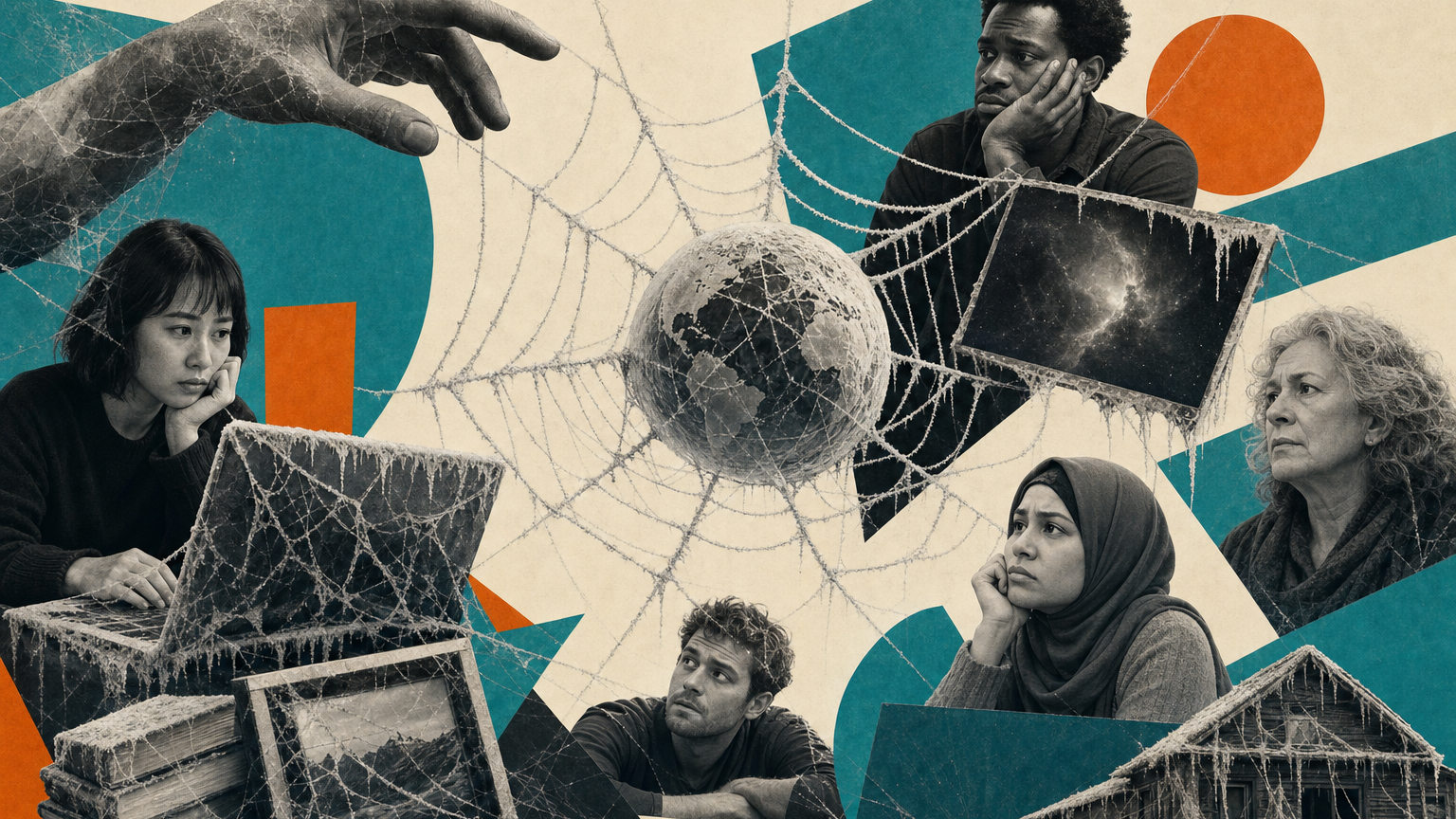
In the Cyberpunk universe (Edge Runners, 2077), there is the concept of the "old net" which represents the remnants of the internet, like shadows of what it once was. The old web is largely crawled by malicious AI's and is where much of the lost data sits due to the cannibalisation of the internet. Despite its inaccessibility and the risks, people still venture into the old net in search of valuable information that could be lost to time.
You can often find that if you ask a chatbot something about a niche piece of software & it answers with total confidence, & the answer is from about three years ago. Applications change so fast nowadays, by the time you've created a tutorial the options that have moved. A setting that has got renamed. A library that deprecated the function it's recommending. It's out of date, & the AI has no idea.
That gap is likely to going to get wider, & the reason why is sitting in AI court documents.
The Verge reported on recently unsealed filings in the New York Times' case against OpenAI & Microsoft, & the language inside them is the story. The companies' own documentation described what they were doing as starting a "doom loop" for the web. Elsewhere, their scraping of training data is characterised as the "largest theft of labor in human history." That's what the people building the thing wrote down while building it which is slightly different than the pitch when generative AI hit the scene where it was called the democraitisation of knowledge.
These tools really do work. I use them every single hour, I have an AI personal assistant that I built that I text and manages so much of my day-to-day, AI saves me hours, & pretending otherwise to score a point would be dishonest. AI's were also built on a scale of taking that the builders themselves, in private, called theft. Both of those stay true at once. Anyone using these tools is standing on ground someone else paid for. I can see the same argument for democratisation of knowledge, I can see that, however, this technology would not exist or be as proficient as it was if they had asked for permission. I also think it's true that they exploited a loophole in copyright law which was never designed to account for this kind of technology while also being largely lawful. Being lawful doesn't mean it was right to have done what these companies did, it does however, not make them in the wrong either. This is why there is such high demand for AI ethics.
The fear is usually that AI will kill the web. I don't think it does. The web survives. Pages stay up, archives sit where they've always sat. What might breaks is the reason for a human being to add anything new.
Let's follow the money for a second. Someone writes a good guide to, say, fixing a specific fault on a specific boiler model. They write it because people search for that fault, land on their page, & some fraction of them click something or trust them enough to call. That's the deal that funded most of the useful web. Now the answer gets extracted & served inside a chat window with no click, no visit. The guide still exists. The reason to write the next one doesn't.
Scale that across a decade & you get something stranger than a dead web. You get a frozen one, more like a time capsule.
The archive stays comprehensive & stops advancing because of human contribution. The most reliable material online ends up being the stuff written before the economics collapsed, roughly pre-2024, when people still had a reason to publish in public. In some ways it marks the end of the industrial economy. Everything after that thins out, or moves behind a login, or gets written by a machine trained on the last generation of human writing.
You've probably already seen the patterns. The chatbot that swears a feature exists in a settings menu that was redesigned last spring. The model that gave a Stanford professor a beautifully formatted legal affidavit full of citations to cases that do not exist, in a document about misinformation, no less. Currency might be the problem, or at least human developed currency, AI can update instantaneously, far beyond that of human capability, but the internet will be less human.
In fairness, AI inherited this problem & has made it much worse.
The web was already being closed off, one platform and feature at a time. Cory Doctorow gave the pattern its name, enshittification: a platform is good to its users while it needs them, then squeezes them to please its business customers, then squeezes those customers to keep the value for itself, then dies. Reddit priced its API out of reach in the summer of 2023 & the third-party apps were gone within weeks. Twitter had cut off free API access months before that. Neither move had anything to do with AI. Both came from the same instinct: value was leaking out of the walls, so build higher walls.
Then the scrapers arrived & found the walls already up & everything already pooled behind them, & read the pooling as an invitation.
I'm often nostalgic about the internet before social media. Personal sites. Forums where everyone knew everyone. Funny videos that weren't there for engagement but just because it was funny. Someone's obsessive page about one narrow thing, maintained for nobody. It might even have been considered human-slop, it badly formatted & wrong a lot. But it was a playground, & every person on it was there because they wanted to be, rather than because a feed put them there. It was the digital world before there was real money to be made, before it was national critical infrastructure and you'd spend hours every day on it for your job. Yahoo closed GeoCities in October 2009 & Archive Team spent the months before pulling down copies before the servers went dark. That's the shape of it. The era ends, a few people rescue a snapshot, & the snapshot becomes the record.
Which is the "old net", near enough exactly from Cyberpunk 2077. The old net still exists but it's fenced. Everyone essentially agreed to stop going there, because going there was dangerous & the fence was easier. The information sits behind it, intact. Nobody adds to it.
We built the fence ourselves, platform by platform, for money. The answer layer is handling the second half for us.
So what do you actually do on Monday, given you're not going to un-invent any of this?
Change what you ask these tools to do. They're very good at the stable stuff: structure, summarising, explaining a concept that hasn't moved in twenty years. They are least trustworthy on anything with a version number, a price, a date, a name, or a law attached. That split is the old net drawn as a straight line. The stable stuff is the archive, & the archive is fine. The rest went stale & nothing's refreshing it. Build the habit of noticing which kind of question you're asking. When it's the second kind, go & find a human source who touched it this month.
So what do you actually do on Monday, given you're not going to un-invent any of this?
Change what you ask these tools to do. They're very good at the stable stuff: structure, summarising, explaining a concept that hasn't moved in twenty years. They are least trustworthy on anything with a version number, a price, a date, a name, or a law attached. That split is the old net drawn as a straight line. The stable stuff is the archive, & the archive is fine. The rest went stale & nothing's refreshing it. Build the habit of noticing which kind of question you're asking. When it's the second kind, go & find a human source who touched it this month.
Then do the less comfortable half. If your organisation benefits from open knowledge, & almost all of them do, notice whether you still contribute any. Publishing a clear explainer or answering properly in a public forum is now unusual. That's a leadership question.
The archive isn't going anywhere. The question is who's still adding to it, & whether your team can tell the difference between an answer & an echo. That's the case for building real AI literacy across your organisation.
Frequently Asked Questions
What is the "doom loop" OpenAI & Microsoft were talking about?
The "doom loop" is a term that appears in OpenAI & Microsoft's own internal documentation, unsealed in the New York Times' court case against them & reported by The Verge, describing the damage their data scraping could do to the web. The concern is that extracting & serving content without sending readers back to the source removes the financial reason publishers had to keep creating it.
Does this mean AI tools are unreliable & I should stop using them?
No. These tools are useful & getting more so, which is exactly why you need to know where an answer came from. The practical move is to sort your questions by type: anything stable, like concepts or drafting, is fair game. Anything with a version number, price, date, name or legal requirement attached needs checking against a human source who touched it recently.
How would I even know if an AI answer is out of date?
You often can't tell from the answer itself, because fluency & confidence stay constant whether the information is current or three years stale. That's the actual risk. The workaround is to ask the tool what it's basing an answer on, & to independently verify anything where being six months behind would cost you something real.
What happens if people stop publishing useful content online?
Future AI models are trained on what's published, so a thinning public web produces tools that are progressively further behind. The archive of good pre-2024 material stays available, but a model that only knows that world will confidently describe menus, prices & rules that have since changed, with no signal to the user that anything has moved.
What can one manager realistically do about any of this?
Two things, both small. First, teach your team to notice which kind of question they're asking an AI, & to verify the time-sensitive ones. Second, look at whether your organisation still contributes anything to the open knowledge it takes from: public documentation, proper answers in public forums. Both are habits.
Jamie Bykov-Brett
Listed as one of Engatica's World's Top 200 Business and Technology Innovators, Jamie is an AI and automation consultant who helps organisations move from curiosity to confident daily use. As founder of Bykov-Brett Enterprises and co-founder of the Executive AI Institute, he designs AI upskilling programmes that have delivered 86% daily adoption rates and a 9.7/10 NPS. His work sits at the intersection of technology implementation and human development, with a focus on responsible governance, practical tooling, and making AI accessible to every level of an organisation.
Get AI Insights Delivered
Practical perspectives on AI adoption and the future of work. No spam.