The most telling moment in UC Today's 2026 enterprise XR briefing has nothing to do with new headsets. It is where IT teams evaluate virtual reality kit using the same checklist they apply to laptops and phones. Encryption. Single sign-on (the system that lets staff log in once and reach everything). Device management. Battery life. Wi-Fi load. The romance has gone, and that is the news.
For the last decade, immersive technology has been sold to leaders as a glimpse of the future. In 2026, the better question is much smaller and far more useful: where does a spatial layer over our existing systems improve learning or reduce risk in work we already do?
XR As A Layer On Existing Systems
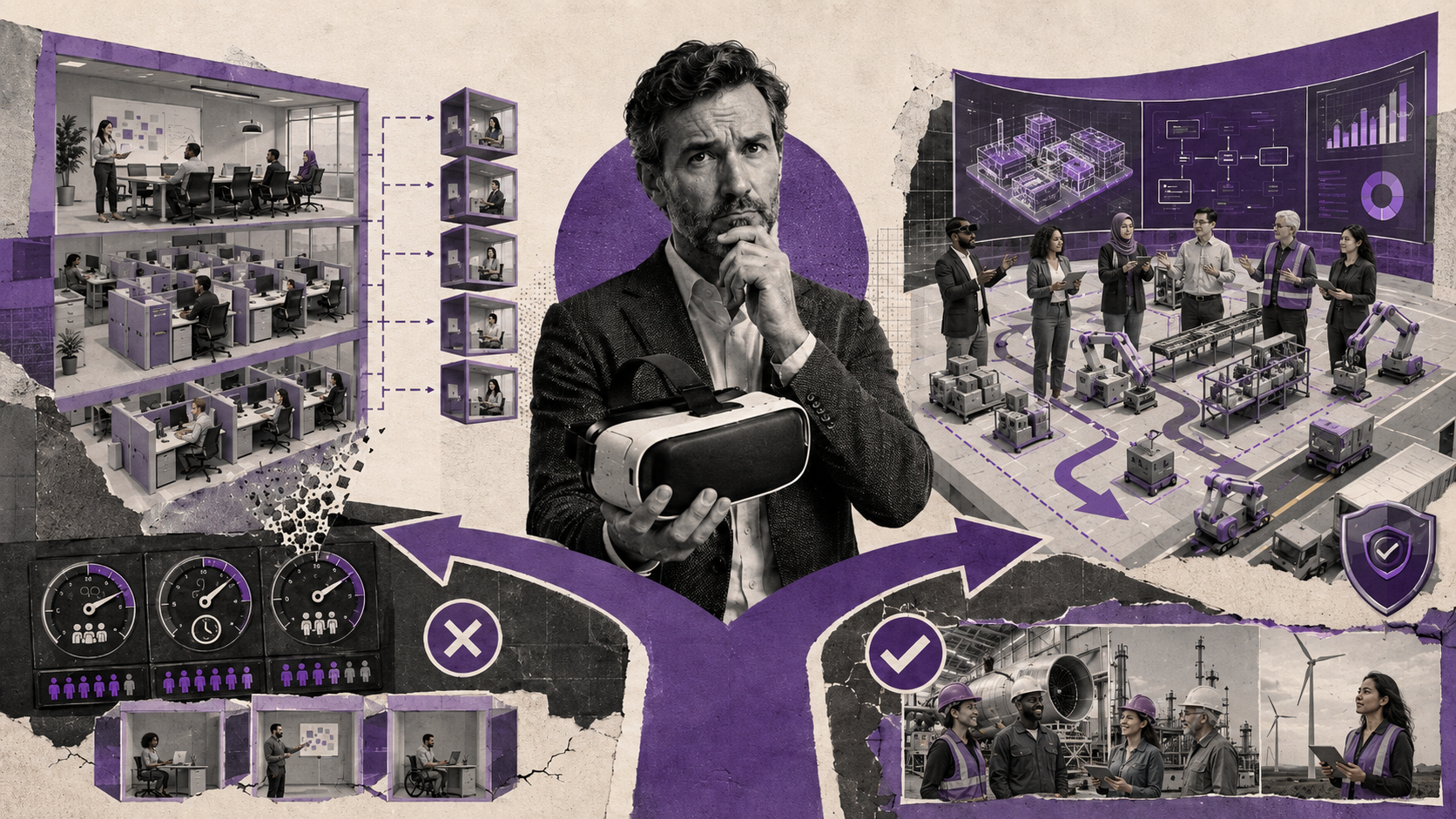
UC Today frames extended reality as a spatial interface layer that sits on top of the tools your business already runs. Think learning platforms, field service apps, customer records, clinical systems. The headset is just the access point. What you are buying is the moment of work it improves.
That reframing changes the buying conversation:
You stop asking "should we pilot VR?"
You start asking "which training pathway has a high-cost, hard-to-rehearse moment that a spatial layer would meaningfully improve?"
You commit to a measurable delta before you buy a single device.
If you cannot name the moment and the metric, the pilot will stall.
Why The Hardware Conversation Went Quiet
PwC's UK analysis, cited in the same briefing, identified 1,550 public examples of XR business usage, with 66% of organisations using VR over AR, led by engineering and manufacturing. The numbers are interesting. The pattern underneath them is more interesting. The sectors leading adoption are the ones with expensive mistakes or rare high-risk events that staff need to rehearse before they happen for real.
A surgeon practising a procedure they will perform six times a year. An engineer learning a shutdown sequence on a rig they cannot afford to take offline. A retail manager rehearsing a difficult conversation. These are the moments where a spatial layer earns its keep. Everything else is a slideshow with a headset on.
The Four Layers Your IT Team Will Ask About
The briefing describes mature XR deployments running across four connected layers: hardware, software, data, and governance. In plain language:
Hardware: the headset or glasses, treated like any other work device.
Software: the apps and how they connect to your existing systems.
Data: what gets recorded, where it sits, who can see it.
Governance: who is accountable when something goes wrong.
If your XR vendor cannot answer questions across all four, you are buying a demo and not the infrastructure.
A Short Test For Heads Of L&D
Before the next pilot conversation, try this exercise with your team:
List the three training moments in your organisation that are highest risk or hardest to rehearse.
For each, write down the current cost of getting it wrong.
Write down the metric you would move with a better rehearsal environment.
If you cannot fill in the third column, pause the pilot. The blocker is the absence of a clear outcome to test against, not the technology.
This is the same discipline that separates a successful AI project from an expensive experiment. The tools are different. The question is identical: what specific work, performed by which people, with what measurable change?
What Changes For Leadership
The shift from pilot to infrastructure means XR decisions now sit alongside other endpoint decisions, with the same security and procurement standards. That is good news for finance, IT and risk. It is also a useful prompt for the rest of the leadership team. If the headset is now boring IT kit, the interesting work is upstream: deciding which moments of work deserve a spatial rehearsal, and which are fine on a screen or in a room.
Name the moment. Name the metric. Then talk hardware.
.png?width=783&height=479&name=BBE%20Logo%20Teal%20Background%20(1).png "Bykov-Brett Logo")
 Jamie Bykov-Brett
·
13 May 2026
·
4 min read
Jamie Bykov-Brett
·
13 May 2026
·
4 min read