.png?width=783&height=479&name=BBE%20Logo%20Teal%20Background%20(1).png "Bykov-Brett Logo")
Exploring The Role of Behaviour In Virtual Worlds: Lessons From The Metaverse For Pandemic Response
 Jamie Bykov-Brett
·
19 December 2022
·
7 min read
Jamie Bykov-Brett
·
19 December 2022
·
7 min read
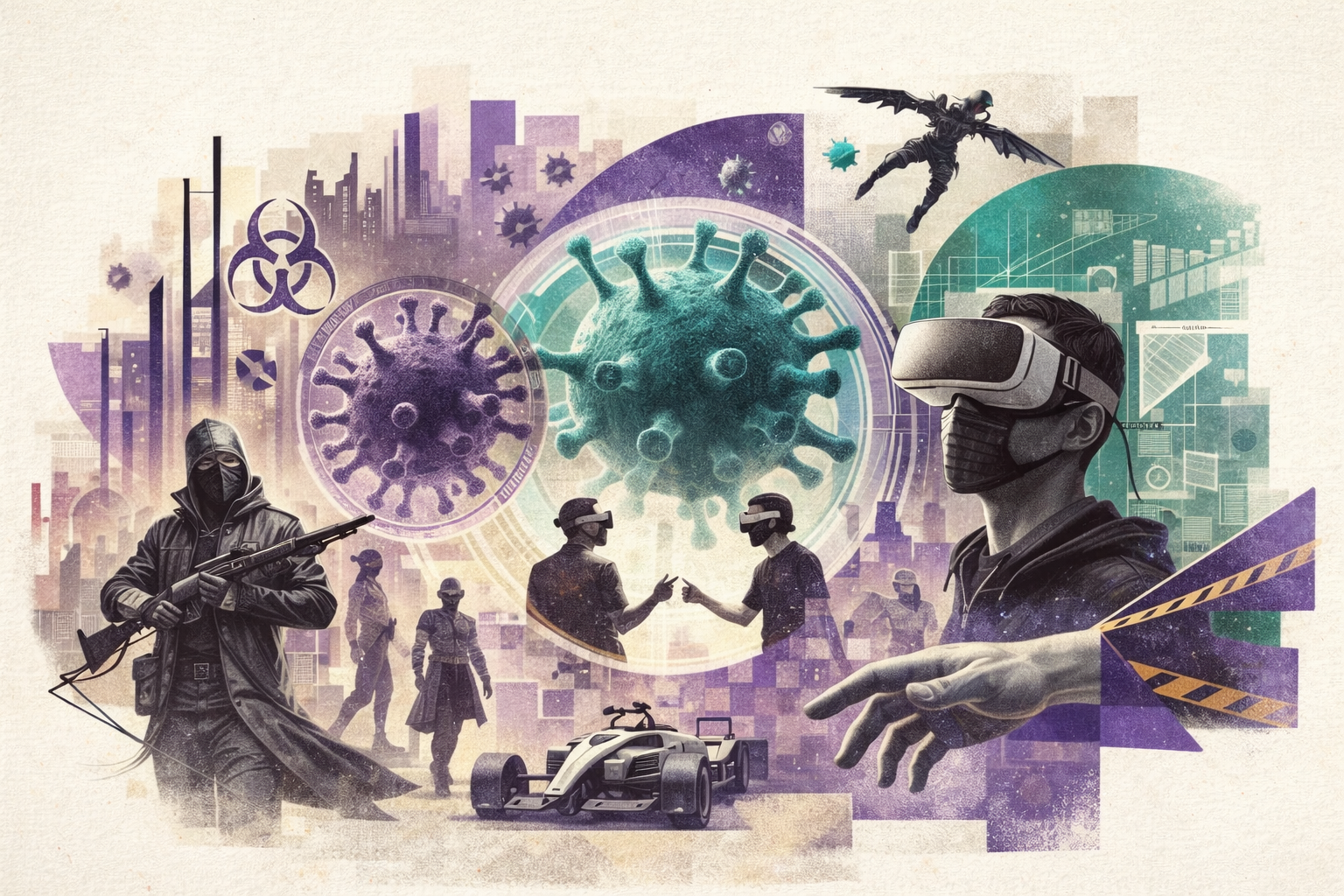
In 2005, the company behind the video game World of Warcraft (WoW), a massively multiplayer online role-playing game (MMORPG), unintentionally started a plague in their metaverse that eerily mirrored the challenges, impact, and behaviours of real pandemics.
You might be thinking: "2005, that's a bit early to be talking about the metaverse." In fact, metaverse worlds are not a new concept. Prior to Meta's (Facebook) announcement late in 2021, there were already many established online virtual worlds that met the criteria of a metaverse. So let's start by establishing why World of Warcraft meets that criteria.
A metaverse is a virtual world that serves as a platform for people to interact with each other and with virtual objects and environments in real-time. WoW meets several criteria:
- Persistence: WoW is a persistent world that continues to exist and evolve even when players are not logged in. Players can return to the same location and find it has changed or been affected by other players' actions.
- Social interaction: WoW is designed to be a social experience, with players able to communicate through in-game chat and participate in group activities such as raiding and player-versus-player combat.
- Virtual goods and currency: WoW has a virtual economy in which players can buy, sell, and trade virtual goods and currency, used to improve a character or purchase in-game items and services.
- Immersion: WoW is designed to be immersive, with a rich, detailed game world and a wide variety of activities and experiences for players to enjoy.
WoW meets the criteria of a metaverse, a persistent, social, and immersive virtual world in which players interact with each other and with virtual goods and currency. Now let's look at how it became an unlikely precursor to the Covid-19 pandemic.
On 13 September 2005, the WoW developers launched a new playing map with an unintended twist. Players in the new area could infect each other with a virtual disease called "Corrupted Blood", originally intended as a minor inconvenience, causing periodic small losses of health. An update accidentally made the disease far more virulent, allowing it to spread easily between players and persist for long periods of time.
The virtual disease spread rapidly throughout the WoW metaverse, causing widespread panic. Several factors exacerbated the spread:
- Stronger players who caught the virus were able to transmit it to densely populated areas before they recovered, the virtual "super-spreaders".
- In-game pets could serve as carriers, and non-playable characters could not be killed but could still spread the virus.
- Non-playable characters (NPCs) such as shopkeepers quickly became major vectors of transmission.
These factors contributed to the rapid spread of the virtual plague, similar to how the bubonic plague spread in the real world. The situation demonstrated how a disease can escalate quickly, cause widespread panic, and underline the importance of taking preventative measures.
One particularly striking aspect of the WoW pandemic was how players responded to the spreading disease. Some took preventative measures, logging off or avoiding high-traffic areas. Others deliberately infected fellow players, behaviour that mirrors what has been observed in real-world pandemics, where some individuals spread disease predominantly due to a lack of understanding of the consequences of their actions.
The WoW pandemic also highlights the importance of effective communication and education in the context of a pandemic. When "Corrupted Blood" first began to spread, many players were unaware of how to protect themselves or prevent further transmission. That lack of knowledge and understanding contributed to the rapid spread of the disease and the panic that followed, a pattern that maps directly onto real-world pandemic response.
The role of online communication in disease spread is equally relevant. In the game, players communicated through in-game chat, forums, and external social media platforms, and that real-time information sharing likely played a role in the rapid spread of "Corrupted Blood". In the real world, social media has been instrumental in disseminating information about COVID-19, accurate and misleading alike, underscoring the importance of fact-checking before sharing.
The game's capital cities, its main social and economic hubs, became extremely difficult to inhabit, and the in-game economy suffered significant disruption.
Ultimately, the "Corrupted Blood" pandemic proved a valuable lesson in disease management and prevention, giving researchers insights into how diseases spread and how people react to them, insights that could help inform future efforts to combat real-world pandemics.
"Traditionally when we do computer-based simulations we know everything about the world," says Eric Lofgren, an epidemiologist who published a 2007 paper on the "Corrupted Blood" outbreak with colleague Nina Hefferman. "The people in those simulations only act the way we tell them to act. Here we get the full view of human irrationality."
This matters because many of the models scientists use to anticipate how a disease like Covid-19 spreads are built on assumptions about individual behaviour. When people act irrationally, as they reliably do, those models break down.
The way coronavirus travelled from rural to urban areas echoes the WoW pandemic. Powerful characters went about their regular business because the illness affected them no more than a cold, yet by doing so, they quickly transmitted the virus to more vulnerable players who were hit far harder.
We saw parallels with healthcare workers falling ill due to a combination of coronavirus and exhaustion. According to Lofgren, some attempted to act as "first responders", travelling to the epicentre of the outbreak and trying to heal infected players, but frequently contracted and spread the disease themselves.
External interventions also played a role. The developers made a deliberate effort to contain the outbreak. Some players effectively isolated themselves by retreating to secluded areas of the game, while others continued to evade quarantine, echoing the hasty exodus from safe zones ahead of real-world lockdowns. There was also an attempt to ask infected users to "tag" themselves to warn others to keep their distance.
The WoW pandemic highlights the potential for online games and metaverses to serve as useful tools for simulating and studying how people respond to different situations and conditions, and for testing the effectiveness of various interventions in a controlled and realistic setting.
The WoW pandemic is not the only example of virtual worlds shedding light on real-world challenges. Researchers have used online games to study human behaviour, social dynamics, and economic decision-making. Here are some ways in which our "URL" interactions can teach us about "IRL" behaviour:
- Social interaction: The metaverse allows researchers to observe how people communicate, form relationships, and resolve conflicts in virtual environments.
- Identity construction: The ability to create and present different versions of themselves, avatars, reveals how people perform their identities online and how they are perceived by others.
- Community formation: Joining communities based on shared interests, values, or goals provides insights into how communities form and function, and the role of social norms and group dynamics in shaping behaviour.
- Cultural differences: Cross-cultural interactions in the metaverse illuminate differences in communication styles, social norms, and values.
- Human-computer interaction: Immersive environments provide insights into how people perceive and interact with artificial intelligence and how it can support or augment human abilities.
As for how the WoW pandemic ended, it took radical, coordinated, global action from the game's creators to stop the spread of "Corrupted Blood".
They restarted the server.
Unlike a metaverse, real life does not come with a restart button, and there are real-world consequences. We are living through the long-term social, economic, and political consequences of the Covid-19 pandemic, the effects of which are exponentially greater than a cautionary footnote for future metaverse architects. Perhaps our observations in the metaverse can offer greater insights into how to limit the harmful impact of the challenges we will face.
Jamie Bykov-Brett
Listed as one of Engatica's World's Top 200 Business and Technology Innovators, Jamie is an AI and automation consultant who helps organisations move from curiosity to confident daily use. As founder of Bykov-Brett Enterprises and co-founder of the Executive AI Institute, he designs AI upskilling programmes that have delivered 86% daily adoption rates and a 9.7/10 NPS. His work sits at the intersection of technology implementation and human development, with a focus on responsible governance, practical tooling, and making AI accessible to every level of an organisation.
Get AI Insights Delivered
Practical perspectives on AI adoption and the future of work. No spam.